
THREE WORLDS DIARY
Announcing 3W Leadership Network
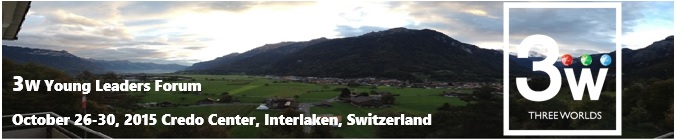
Our Three Worlds Team is very excited to announce the creation of the 3W Leadership Network which will be launched in Interlaken, Switzerland October 26th-30th, 2015 with a special Young Leaders Forum. The 3W Leadership Network will enable young Church of God leaders in the Europe/Middle East to be in constant contact and do ministry together across borders in a way that has never been done before. It raises the level of inner-connectivity to a whole new level and will be a source of encouragement, synergy, strategy, and dynamism for the whole Europe/Middle East Church of God Region.
1 Who will be attending the Young Leaders Forum?
The goal is for this network to be run and sustained by regional leadership. We are inviting an initial group of young leaders from the following countries: England, France, Holland, Germany, Italy, Hungary, Bulgaria, Ukraine, Russia, Lebanon, Egypt, Morocco, Algeria, as well as the USA and Canada to begin with. The vast majority of these young leaders speak 3 to 4 languages. Nearly all of them are fluent in English. They range in age from 20 to 45. Samir Salibi of the Paris Church of God, Sarina Hennig of the Church of God in Hannover, and Laszlo Debreceni of the Church of God in Hungary will be the regional leaders of 3WLN with assistance from the 3W team.
One of the goals of 3W and of this new 3W Leadership Network is to work closely with Church of God congregations in North America as they deal with new post-Christendom realities. We hope the success of this network will have a direct impact on the Church of God globally.
2 What is the 3W Young Leaders Forum?
In a 2008-2010 global study of the Church of God commissioned by then General Director Ron Duncan (Mosaic), it was found that three key challenges the Church of God faces in almost every Church of God country in the world are: 1) Lack of young people in church and in ministry. 2) A lack of support for pastors and people in ministry under the age of 35 and 3) A lack of inner-connectivity and extreme isolation due to the Church of God’s emphasis on autonomy and its lack of functioning structures to bring direction, vision and unity.
In the 21st Century, it is vital that there be new generations emerging in ministry, young people filling our churches, and clear ways for the church to create cross-cultural synergy. Mechanisms have to be created to sustain a higher level of networking and coordination.
Our Three Worlds team desires to create the first ever multi-national network of CHOG leaders under the age of 45. The 3WLN (Three Worlds Leadership Network) will encompass 16 countries in the Europe/Middle East and bring together all key youth leaders biennially (for training, encouragement, and synergistic regional strategizing). The network will be a source of camaraderie, synergy, ideas, and support. Camaraderie is particularly important and isolation is particularly deadly. In many of our countries, the percentage of Evangelical Christians is between .25% and 4%. Many of our young people have never been in a room with more than 5 or 10 Evangelical Christian youth. Events that bring them together are enormously inspirational and healing in a way that North American, Latin America, and African Christians cannot understand because the European and Middle Eastern cultures are so deeply secular and/or hostile to Christianity. The question is whether this effort can become exponential and sustained over the long term, and 3WLN is meant to do that for this region.
3 Where is the Forum?
The first meeting is planned Monday, October 25th – Friday October, 30th at the Credo Center in Interlaken, Switzerland. This location is ideal for the initial event as it allows everyone to meet and stay together in one central location. Many of the young leaders are able to drive to Switzerland, saving on transportation costs. Others will have low-cost carrier options into Zurich, Basel or Bern. The Forum will be a platform for establishing further interconnectivity and regular interaction via the web, regular forums, 3W Seminars, conferences, youth camps as well as opportunities to attend each other’s ministry events.
4 What is the Format of the event?
The Conference will feature a combination of spiritual, exemplary and testimonial sessions. Representatives from different regions will have the opportunity to share the challenges and successes of their ministry in their home countries. There will also be break-out sessions focusing on youth ministry, pastoral ministry, and music ministry. Matt Anderson, Preaching Associate at Crossings Community Church in OKC, will be the keynote speaker throughout the event and messages will also be delivered by Ken Oldham (3W- The Middle East) and Daniel Kihm (3W- The Netherlands). There will also be a Q&A session, as well as a Roundtable Discussion on the purpose and vision of forming a network. All the events are are structured to bring about new friendships and lead toward a commitment service that will challenge all of us to raise our level of commitment to each other and to the Lord in ministry. It will be a powerful event.
5 Actions of 3W Leadership Network (3WLN)
The October Young Leaders Forum will be an initial meeting for young leaders throughout the region. From this meeting, we hope to create an ongoing 3W Leadership Network (3WLN). This network would be a commitment to further interconnectivity and regular interaction via the web, regular forums, 3W Seminars, conferences, youth camps as well as opportunities to attend each other’s ministry events. The network will assist in the development of local youth programs, young singles and young married couples programs in each country. This will be the first international group of young leaders in the Church of God that will grow up doing strategic, coordinated international ministry together across multiple countries, knowing each other, having regular contact, and changing the world for Christ.
6 When will 3WLN meet in the future?
We hope that the 3W Leadership Network will informally bring together all key young leaders at least biennially for training, encouragement, and synergistic regional strategizing. Individuals and small groups of the network will also support one another’s ministry events. For example, Italy leadership will be joining Bulgarian Youth Camp in 2015 and UK Young Leaders plan to attend Budapest Lectures in the future. 3W Seminars may also be offered in their home countries. The delegates in Switzerland will be able to decide at a special roundtable session how they would like to move forward.
7 Funding 3WLN
We do not want to foster financial dependency and we hope to create something that can be as self-sustaining as possible. However, churches in Europe tend to be very small (10 to 30 on average) and have very few resources.
Our desire is to cover expenses in several ways:
1) Grants
2) Three Worlds Ministry Budgets
3) 3WLN member contributions
4) International countries contributing to support their young leaders
5) North American Church of God Partnerships/Sponsorships
8 How can my church be involved?
Many of the leaders who have been invited come from small congregations in Europe/ME and may have difficulty with paying the cost of room and board or travel expenses. The cost of Room/Board for the full week is $350. Travel expenses may vary depending on if delegates require flights. If you or your church would be interested in sponsoring an individual or delegates from a specific country please contact us at pj@three-worlds.com . Gifts of sponsorship can be sent online or through Project Link - NextGen Fund (42.30401). Make checks payable to Church of God Ministries and indicate the project number and “3WLN” on the memo line.
Church of God Ministries
c/o Project Link
PO Box 2420
Anderson, IN 46018-2420
3W Seminars: Children and Family Ministry
This month, Three Worlds is excited to host a team from County Line Church (Auburn, Indiana) to lead seminars in Paris and Rome on Children and Family Ministry. The team includes Nathan Tatman, 3W Roundtable participant and Mission Advancement Pastor, will be joined by Mary Ellen Rayle who is County Line’s Kids Ministry Pastor, and Chelsea Buckwaler who is the Kids Ministry Assistant. The team will present the seminar at the Church of God congregation (Eglise de Dios) in Paris on March 21-22, and then again for Italian Church of God congregations in Ostia on March 28-29.
Joining the presentations in Paris will be Ken and Keli Oldham, 3W Middle East. The EDD in Paris was planted by Michel Fegali, a Lebanese graduate of the Mediterranean Bible College, and it consists largely of believers from Lebanese, Egyptian, and other Arabic speaking backgrounds. The congregation worships in French and Arabic each week, but their children’s ministry is offered only in French. The EDD pastoral ministries have recently been handed over to a young Lebanese born believer, Samir Salibi. The Oldhams have been getting to know and encouraging Samir via Skype video conferences over the last year. With the work the Oldhams are doing with congregations in Egypt and Lebanon, and the weekly children’s ministry program they offer to Egyptian children in English, this is a great opportunity to begin creating relationships for future partnership and mutual support between the Church of God in France and the Middle East.
We asked each of the County Line team to answer a question about the upcoming seminars for this post; here are their questions and answers.
Nathan, as a Missions Advancement Pastor who has been actively supportive of the approach of 3W in Europe and Middle East, what excites you most about the future of the Church in our region?
"I am very excited for this next season of ministry and church life within the Europe and Middle East Region. Over the last four years I have seen exponential increase in connectivity amongst churches and leaders, a hunger for partnerships with pastors and churches in Europe, Middle East, and North America, the next generation of leaders adding a voice to the local church, and health beginning to permeate in these congregations. The church in North America must take notice of what is happening as we are in the midst of seeing God do some amazing work in and through His people and the local churches. I believe the foundation has now been laid for these next years to see these once struggling churches and isolated leaders to flourish in the gifts, abilities, and ministries that God has designed for them."
Mary Ellen, your approach to Children's Ministry is family-centered; what are one or two things you hope to encourage or inspire the congregations in France and Italy to do as they minister to the next generations?
"One of the best opportunities the Church has to reach more people for Christ is through children and families. I am looking forward to meeting with the congregations in France and Italy to share my passion about the great power we have when the family and church unite in shaping faith development and nurturing spiritual growth. I want to encourage them to think about creative and meaningful ways to include children in their worship and church life. I hope leaders will consider prioritizing ministry to children and families in their planning with the potential of impacting more people for Christ. And ....we hope it is fun! We are bringing some engaging ideas for Bible stories, memory projects, crafts and games that will help all of us, kids and adults, learn to look with fresh eyes and listen with understanding ears."
Chelsea, you are the youngest on the team presenting next week; what are you most looking forward to experiencing as you interact with Christians in these different cultures?"I am so excited for this opportunity and eager to see how God brings everything together. I can’t wait to meet and build relationships with the people in France and Italy. God has placed on our hearts Bible stories, activities, and teaching methods to share about Children’s Ministry. Although we are coming to share with other church leaders from different cultures, I know that we will be learning from them how they do ministry and interact with each other. I am very thankful and honored to be a part of this workshop and look forward to sharing my heart for family and children. I have grown already through preparation and prayer over the last several months. God is amazing and doing great things and I can only hope to be a light to the people we meet in Europe."
Three Worlds is so thankful for the partnership and support offered by congregations like County Line. We are hopeful for the seminars in the next two weeks, and we want to invite you to pray with us for the equipping and inspiration that will take place in each location. Pray also for the Church throughout the region to intentionally, creatively, and powerfully work to pass the faith on to the next generations.

3W's Fight Against Sex-Trafficking

The problem of sexual slavery and sex-trafficking has exploded around the world in the last 15 years. New technological inventions, open-borders, conflict, and the ease of travel at the beginning of the 21st Century has made it easy for sexual slavery networks to erupt around the world. Approximately 20 million people are caught in sexual slavery and 98% of those trafficked are women and children. Three Worlds works in three regions where the problem is particularly acute: Western Europe (home to street prostitution and many brothels), Eastern Europe (the source of many of the trafficked women and children), and the Middle East (where conflict and refugee migrations are making it easy to prey upon women and children). Becoming involved in the fight against this scourge was not an option, but absolutely necessary.
Berlin is one of the most international and open cities in the world. It is also a city connected to many of the networks involved in sex-trafficking. The number of red-light districts has increased from 2 to 7 in just the past couple of years. Five years ago as part of her ministry on the Three World's Team, Rhonda Philips (3W-Berlin) began working at a cafe that provides food, shelter, counseling, and friendship to women working as prostitutes on the streets. The vast majority of these women are working the streets against their will. It is common for women from Eastern Europe to be promised work as domestic helpers, nannies, or other jobs in Western Europe, only to find that they have been tricked and forced into slavery. In some cases, "boyfriends" lead them to Western Europe on a romantic vacation and lead them to apartments where they are repeatedly raped, enslaved, given a crushing debt to pay-off and have their families back home threatened. Others were forced into slavery or captured as children and have been living on the streets ever since.
In the past few years, Rhonda (who has spent more than 20 years on the mission-field and can converse in English, Russian, Hungarian, and German) saw her role in the cafe increase. Over the years, there were women that longed to escape and who did with the help of Rhonda and her friends at the cafe. It became increasingly clear that what was needed was a long-term shelter; a place where the women could safely escape their pimps, get off the streets, and begin the process of rebuilding their lives and returning to their homes. Surprisingly, Berlin--a city of 4 million people, is not remotely prepared to provide this kind of shelter to victims.
Rhonda's dream of creating a shelter became a multi-denominational reality in a very short-time. A talented team assembled around Rhonda and includes Josh and Audrey Weiger (3W-Berlin) our newest team members. Rhonda, Audrey and the rest of the team began the process of registering a new non-profit in the city of Berlin and it is called Pink Door (see website). The speed at which this has come about has been a God-ordained thing. The need is immense and the amount of women wanting to escape (and the danger) has increased dramatically in the last couple of years. Everyone understands this is a tremendous need and the city of Berlin needs faith-based organizations to help fight the problem. Even a local mayor of a suburb is wanting the Pink Door project based in his town. In November, Pink Door's official registration as a recognized Non-Profit was granted. We are now at the phase of finishing up the writing of the business plan (which has already been steered considerably by Audrey Weiger), applying for funds for the project and beginning the training of the staff. We will first open an office in the city, which will not only be an "office," but also a counseling center. Our target date for opening is late Spring 2015. The shelter will come later in Fall 2015.
Meanwhile, Rhonda and the team continue to minister to women and see them accept Christ, escape from slavery, or receive love with no strings attached. They are also assembling a team to go into the brothels!
Pink Door is just the beginning. It will provide more opportunities for our ministry partners to serve the women, furnish our shelter, and fund this safe-space. With our regional network, our dream is to continue building on Pink Door by helping with job-training, re-location back home, impacting a new generation with scholarships for women and children, and even assist the women in starting businesses. The first step, however, is creating a safe space where the life of sexual slavery can be left behind.
The team that has been assembled is outstanding, the need is great, and the strategy is wholistic and long-term. Three Worlds is looking for individuals and churches that want to help fund these first key years of the shelter's expenses, or women that are willing to work as volunteers in the near future, and people that want to contribute to invest in the new life of these women. If you or your church are interested in joining our 3W team as we launch Pink Door, please go to the CONTACT US page and write us a message. We will respond immediately. We can't do it without you.
Two Weeks in the Life of the 3W Team
Is there a way to help the Church of God be more inner-connected, more effective at creating support for people in ministry, and a more intentional way of engaging people? Our Three Worlds team believes that the answer is "Yes," and we have designed our whole Europe-Middle East strategy and team to achieve those goals. So four years after the team was launched, how is Three Worlds doing?
Just in the past two-weeks, you can get a glimpse at how effective the team approach has been. Last week, Daniel and Christy Kihm moved into their new permanent house in the Netherlands. They were helped by 3W Teammates the Philips (3W-Berlin) and XZ Berlin intern Catherine Groeber from Germany. Previous interns have come from the U.S.A, Hungary, Singapore, Spain and other countries. Just a few days before, Christy Kihm (3W-Netherlands) had been busy setting up the first ever Europe/Middle East European Youth Network which will meet for the first time in Interlaken in October of 2015 bringing top youth leaders from 16 countries together. Audrey Langford (3W-Liverpool) is also the co-organizor.
Now the Kihms take a group from the Netherland CHOG to Belgium for the annual Paris Church of God Retreat which was moved to Belgium this year to welcome French-speaking people from the Netherlands. Among this group, will be a number of French-speaking Africans that are part of the Church of God in Europe, including Kenneth Morikang of Bulgaria/Cameroon, Emmanuel Zivo of Germany/Senegal and many from the Geleen Church of God which includes people from the Congo, Ivory Coast, and Angola. An "Africans in Europe" network is starting to take a form which could lead to lots of exciting possibilities both in Europe and Africa.
Meanwhile, Kelley Philips (3W- Berlin) and Ken Oldham (3W-Middle East) went to Frankfurt, Germany to meet with the National Ministry Leader of the German Church of God to make sure that the excellent relationship between Germany CHOG and USA CHOG continues to grow as we expand our inner-connectivity in European-Middle East ministry. Relations have never been better between the two countries. Three Worlds team members will be presenting at the next European Theological Meeting in 2015. Ken Oldham now sets off to co-organize the tri-annual Budapest Lectures that were started in 2012 along with 28 year old National Leader Peter Kiss. and 33 year old Pastor Laszlo Debreceni. The Budapest Lectures are open to all CHOG people. This latest set of lectures will be the first led by the Russians from Chelyabinsk and will have attendees from Lebanon, Bulgaria, and Hungary. Previous presenters have been from the USA and Germany.
The Simpsons (3W Bulgaria) were at the at a 3W Seminar in Rome for the Italy Church of God, which was in partnership with Healthy Growing Churches Network and County Line Church of God (Auburn, Indiana). It's part of our Italy Expansion Initiative which has helped launched 2 church-plants and preparing for a third as well as a new, highly-innerconnected Italy youth-group. The Simpsons now prepare to meet up with Ken Oldham in Budapest along with a group from Bulgaria.
The Langfords (3W Liverpool) just landed in the U.K to take up residence in Birkenhead, England, reaching out to youth in one of the countries most difficult and economically-depressed urban areas.
Last, Patrick (Regional Coordinators) was in Western Canada and Ohio meeting with regional partners that are interested in supporting this healthy way of missions continue to expand in Europe and the Middle East. While not every team member is mentioned in this past 2 week summary, all of them are constantly doing this type of work.
Everyone works for the common good and women are highly-empowered on the Three Worlds team and are often the key leaders. Keli Oldham (3W-Middle East) travels to the region on her own without Ken (and drives through Cairo traffic)! Our most important 3W event ever is in the hands of Christy Kihm and Audrey Langford, and Rhonda Philips is spearheading the establishment of the Pink Door for women caught in sex-trafficking. These two weeks are an accurate snapshot of how the Three Worlds team is trying to help the Church of God at the dawn of the 21st Century. It's a new day in the Europe-Middle East Church of God. This is a totally new approach and we are glad to see God blessing it. Thank you for supporting our team!

Patrick Nachtigall's New Book: "In God We Trust: A Challenge to American Evangelicals" is Coming Soon

Patrick has written a new book that deals with the americanization of Christianity the future of the United States, and how American Christianity looks when viewed through the prism of historical and global Christianity. It is an eye-opening look at the way American culture and myth has formed what we think of as "Evangelical Christianity."
The book suggests that there are three gods that have always dominated American Christianity: Religious Freedom, Radical Individualism, and Materialism. A combination of historical amnesia and an obsession with apocalypticism has created a form of Christianity that is very americanized and exported all over the world. "Caught between triumph and apocalypse" American Christianity veers from cultural arrogance to deep pessimism about the future of the country--a pattern that has existed for more than 400 years.
The book also deals with the rise of non-Western Christianity and geo-political questions such as the rise of China, Russia's renewed threat, and the rise of Islamic terrorism as well as making predictions about America's political, economic, social, and religious future. Heavily documented and intentionally citing many Christian and evangelical scholars, the book makes a powerful case that the American church needs to re-examine itself at this point in history. You will never look at American Christianity in the same light again, but you will walk away with a more Globally-minded, historically accurate view. The book is released in November. Order now
here.
NOVEMBER 2014
Why Care About Missions in Europe? These 10 Answers May Surprise You!
What kind of response do people get when they decide to support ministry in Europe? Here are some samples:
"So you are going on a ministry trip to Paris? Yeah, right!"
"A work-camp in Italy? You mean a vacation right?"
"I'd rather go to Africa or someplace where they need Christianity."
"The Europeans had their chance. I'm going to support a place where Christians have never heard the Gospel."
These kind of responses are what some people receive when they decide to help the Lord's work in Western Europe (Eastern Europe is a different story, associated as it is with poverty and communism). But when people respond this way, they are showing their ignorance about the current state of Christianity around the world. Here are some reasons why you should care about missions doing work in Europe:
1) Non-Western Growth vs. Western Decline: Today Africa has over 390 million Christians (3/5ths of the continent), Brazil is the 2nd largest Evangelical nation in the world, China is experiencing the fastest growth of Christianity in history. Many of the places where the West concentrates its missionary efforts have an abundance of churches, leaders, and resources. These countries are now sending missionaries to the USA. In Europe, however, the church struggles in isolation, but is full of sincere Christians needing help to make an impact in their communities.
2) They have not heard: For many Europeans, it has been 4 generations or more since there was a religious believer in the family. Many countries in Europe saw widespread religious belief disappear after World War I, or at the latest, World War II. So this means that even the elderly may not have ever heard the Gospel message in any form. Shouldn't they get a chance to hear or is the Gospel only for non-Europeans and North Americans?
3) Europe is pagan: The "Christianity" in Christian Europe has been greatly exaggerated. Through most of Europe's history, it has mostly been a pagan society with people following superstitions and local religions that were sometimes incorporated into a state religion. Even Calvin and Luther complained about the few people that were actually involved in the church in a serious way. The very fact that Christianity was institutionalized by Emperor Constantine set up the foundation of Christendom which would limit the dynamism of Christianity. Europe needs genuine Christian movements as opposed to state-sponsored or forced Christian initiatives.
4) What we learn doing mission in Europe can benefit the American Church. At Three Worlds we see how quickly the U.S.A. in particular is entering into a post-Christendom atmosphere. As America secularizes, we feel that the work we are doing and what we are discovering in the European context can be of use to the American church. You should care about Europe because the next generation in the U.S.A. will look like Europe.
5) The rate of born-again Christians is small. In many European countries, the Evangelical community is less than .25% of the population. That is less than a quarter of one percent! It means that we are literally talking about a few thousand people in large countries like Poland, Italy, or Czech Republic. Very few people are sharing the life-affirming gospel of Jesus Christ.
6) If European Evangelical churches close, they may never re-open! In countries like Greece or Bulgaria, you cannot take for granted any Evangelical church that has the permission to be open. Local laws and the state church can make it extremely difficult to own property, register as a legal church, or bring in missionaries. Even if a church is down to 10 people, it may be vital to keep it open or else there will be no way to get back into that particular European country. In many places where the Church of God operates in Europe, we cannot afford to let churches go under. This is also true in the Middle East. Our registration as the Church of God is golden in most of these countries and cannot be allowed to lapse.
7) There are many lonely Christians in Europe trying to stay encouraged as they are vastly outnumbered. Most churches, pastors, and believers in Europe are very lonely and desperate to connection to any other believers. Unlike many believers in Asia, Africa, and Latin America, European evangelicals are extremely isolated not only from other Evangelicals (a given), but even people of any kind of religious persuasion whatsoever! And few churches in North America bother to connect to lonely Evangelical churches in Europe.
8) There are not enough workers, experts, and helpers in European churches. Because churches are small, it is not always easy to find people that are talented at church management, children's programs, youth, theology, and many other areas that North Americans take for granted. We need North American churches to pass on their talents and skills to our sincere workers who are eager to learn.
9) Because it's Not About You and Your Image. Let's face it. Some people love going to poverty-ridden places because it seems much more dramatic and sacrificial. But we are called to go to those that have never heard. Jesus says nothing about the conditions or geographical location, but rather teaches us to go the whole world. That includes Western Europe. There is poverty in Europe, (particularly Eastern Europe), but it is the spiritual and eternal poverty we should focus on above all else.
10) Because the world comes to Europe: Berlin, Barcelona, Paris, Rome, Athens--all of these places put you in contact not only with the locals but with people from every continent. Many of these cities are filled with people that would love to attend evangelical churches for Latin Americans, or West Africans, or Chinese, or Koreans. Globally connected as they are, it's easy to impact the rest of the world with the Gospel when reaching international people in Europe for Christ.
Consider the importance of investing in the church in Europe. We need your skills, talents, and resources. It is a gorgeous continent that has a lot to teach us not only about Christian history, but about the whole world in general. Three Worlds is committed to making a big difference in Europe and using that to touch the world. Won't you join us?
3W Team Keeps Growing
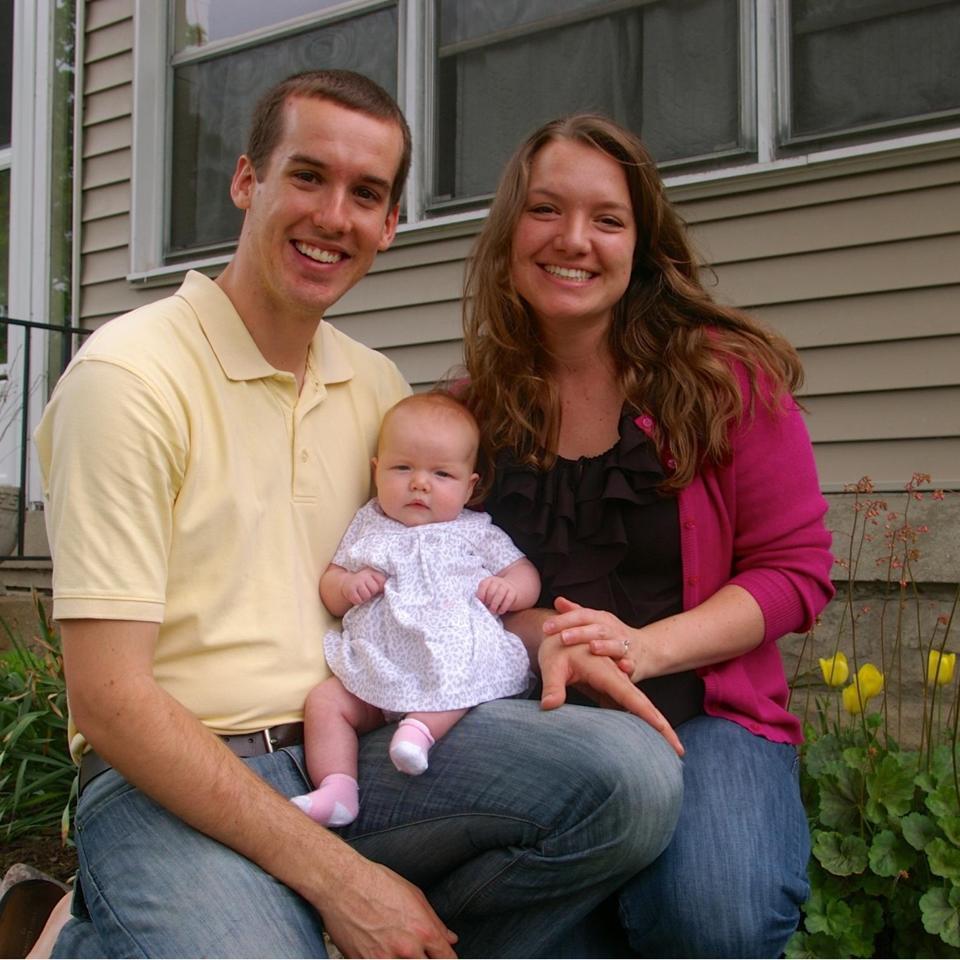
SPECIAL 3W NEWS!!! The Three Worlds Team keeps growing! We are so thrilled to announce that Josh and Audrey Weiger (and baby Emma) are joining 3W to work regionally in Europe and the Middle East based out of Berlin, Germany.
The Weigers... will be continuing to develop the emerging 3W Europe/Middle East youth network and pay particular attention to lending strategic support to youth workers and youth groups in the region while creating a new level of inner-connectivity.
Audrey will be joining the Philips in Berlin as 3W seeks to expand its ministry to women and children caught in human trafficking and sexual exploitation.
Their motto is: “Love God, Love People.” They are passionate about bridging generations, building up young leaders, equipping others to fulfill their God-given dreams, and using business as mission to provide for God’s people.
“We enthusiastically accept the call to join the Three Worlds team."
Audrey was born in Ohio and worked recently for Anderson University admissions for eight years. Her undergraduate work in communications (public relations), Christian ministries, and German, as well as her MBA, were done through Anderson University. She has studied in Austria and teaches at the Anderson University School of Business. She ran a nonprofit organization, Bound For Freedom, with friends from college, making and selling handmade journals. Proceeds went to organizations that supported women with HIV/AIDS and women emerging from sex trafficking.
Joshua was born in Maryland and moved to Alabama at the age of eight. He’s pastored students and families at Park Place Church of God for seven years and brings innovative ideas and superb interpersonal skills to youth ministry. He also has served as a 3W Seminar speaker in England and France. He completed his undergraduate studies in Christian ministries at Anderson University and interned in two youth ministries and with the International Youth Convention, helping to plan and coordinate IYC 2008.
Audrey and Joshua are the parents of the delightful Emma and are expecting their second child in the fall of 2014.
You can support them by giving to PROJECT # 42.10094 at Church of God Ministries. We hope to have them on the field by the fall of 2015. Pray for them as they begin the difficult fundraising process.

Introducing 3W America: Seminars for the American Church

We are excited to announce "3W America." These are 3W Seminars that are meant to be held in the North American church when we are on home-assignment. It is another way for us at 3W to add-value and give back to the North American Church that supports our work. The topics will be relevant to the North American church and will share what we have been learning as we face ministry in the complicated 21st Century global environment. The more we can share and exchange ideas, the stronger all of our churches will be. Our Three World's team is committed to serving the church in North America as well as the Church in Europe and the Middle East. Below are our first dates:
SEMINAR TOPICS 2014-2015
1) The Three Worlds of Christianity: The Changing Face of Christianity in the 21st Century
Christianity is growing and changing at a dramatic speed. This seminar discusses how global Christianity is present in three worlds 1) Traditional 2) Post-Christendom and 3) Non-Western and the challenges and opportunities that rapid Christian growth and rapid Christian decline bring, as well as how to engage the church in the future. (90 Minutes)
2) Is Europe's Past, America's Future? The Challenge of Secularism in America.
Christian belief seems to be in rapid decline in the United States. Why has secularism grown so rapidly and how does American secularization compare with Europe's secularization over the past 400 years? (90 minutes)
3) Developing an Effective Mission-Strategy for Your Church
How do you create a global missions reach for your local church? This seminar covers how churches can learn to effectively engage with other countries and with missionaries. It helps churches understand how to help without hurting, how to have proper expectations, accountability structures, how to maximize their churches skills, and most importantly, how to leave the countries stronger than before. (2 hours)
4) The Challenge of Missionary Life: What You Need to Know
This seminar helps the American church understand the life of missionaries, their challenges, the pressures they face, and how a church can better and more thoroughly support the missionaries they support. Also useful for those considering being missionaries. (90 Minutes)
5) Is the Middle East Blowing Up? Understanding Recent Events
The Middle East has entered into its most destabilized period in decades. What is happening in the world of Islam and how frightened should we be? This seminar examines the growth of Islamic Fundamentalism, the challenges various countries in the Middle East are facing, the effects of persecution on Christians, the conflict between the U.S. and other nations. (90 minutes)
6) What's Going on with 3W? A Comprehensive Look at the 3W team in Europe/Middle East
A country-by-country and missionary-by-missionary look at the ministry being done by 3W team-members in 16 countries throughout Europe and the Middle East. (90 minutes)
7) Mosaic: The Future of the Church of God
The Church of God (Anderson, IN) is at a critical cross-roads. This seminar is based on the findings of a two-year global study of the Church of God presented in the book "Mosaic: A Journey Across the Church of God." An overview of the global Church of God is presented as well as the top challenges facing the Church of God are discussed in detail. The seminar also discusses how the Church of God is well-configured for the trends of the 21st Century. (2 hours)
Churches that host 3W America Events are invited to choose 2 for a Saturday presentation, or Friday night or a Sunday night. Some can be in done mid-week. 3W America weekends can provide a lot of useful information for the local church, or the State or District.
Contact Patrick Nachtigall for scheduling and details.
Is this the Beginning of World War III?: Making Sense of 2014
As Russia faces off with the West and terrorism hits the skies again, the news looks increasingly bleak around the world. The European Union is fragile, much of the world is in a recession worse than the one hitting the United States, China's presiding over the world's largest financial bubble, North Korea acting increasingly erratic, the Middle East is spinning into chaos, and Latin America's two-decades of stability look to be coming to an end. Is this the beginning of World War III? Is something unusual going on, or is this just the result of too much satellite T.V. and our having got used to a Post-Cold War era of peace?
First of all, much to the disappointment of Apocalypse-predictors everywhere of all religions, even if we enter into a period of extended chaos, life-expectancy has never been higher, infant mortality never lower, the poor never wealthier, nor has the world been as free from international and domestic conflict than it is now. If you had to pick a century to live in, this is the one. The Four Horsemen of the Apocalypse were far scarier in the 20th, 19th, and 18th, Centuries.
What is happening, is that we are seeing the inevitable counter-action against the latest wave of hyper-globalization that I wrote about in 2006 in my book "Passport of Faith." Since the fall of the Soviet Union in 1991, the speed of global integration on the cultural, economic, technological, and political levels has been unprecedented. While some form of globalization is always occurring throughout history, this is an era of hyper-globalization of which we have only seen two previously (the Age of Exploration and the Industrial Revolution). "In this era we have seen the birth of the Internet, the shrinking of the microchip, the establishment of new nation-states, the growth of immigration, the creation of mega-cities, the integration of world financial markets, and the practicality of satellite technology. At the same time, these rapid changes are responsible for new challenges and dilemmas in the medical, environmental, financial, political, and social spheres. Cloning, the homogenization of cultures, global stock market crashes, the disintegration of nation-states, environmental degradation, and the rise of transnational terrorism all remind us that globalization brings benefits as well as challenges. Globalization always demands radical change and adaptation." (p. 258 Passport of Faith).
That rapid, large-scale change causes global instability eventually, even though the foundation is being set for an era of greater prosperity and stability in the long-term. In POF, I spoke of the counteraction to globalization that would come and that it would involve competing ideologies, a new divide between rich and poor and lead toward shaky alliances, imperial overstretch, great power rivalries, an increase in terrorism, and anti-Capitalist movements. Today 8 years later, I suggest that the prediction was accurate and in 2014, we can see 3 key global trends that are threatening to cause the counter-action to Globalization that is now ushering in a period of instability. They are: 1) A Clash of Fundamentalism 2) Disillusionment with Democracy and 3) Severe Wealth Disparity.
1) A CLASH OF FUNDAMENTALISM
Samuel Huntington was much criticized for his politically incorrect article and book "The Clash of Civilizations: the Remaking of the the World Order" which predicted that in the Post-Cold War era, we would see religion and cultural differences re-assert themselves. He spoke of new fault lines between the Orthodox East, Islam and it's neighbors, and the West. The war in Yugoslavia in the early 1990's was a foretaste of this.
Huntington has been proven right in many ways, but what is becoming clear is that--in general--nationalism and fundamentalism has become a response around the world to globalization's rapid change. It is not just Islamic Fundamentalism that is having re-awakening, it is Hindu Fundamentalism in India, Jewish Fundamentalism in Israel with Netanyahu government following suit, and Christian fundamentalism from Uganda to the U.S.A. making itself known. Fundamentalist movements are often fueled by time of rapid change and modernization.
There is political fundamentalism as well. The polarization of the U.S. Congress is mirrored in a number of countries. Germany is increasingly divided into two, and India is seeing its political system paralyzed. Thailand, like many countries, is divided between the rural class and the more urbane, wealthy class. Leftist extremists are making a comeback in Latin America, Right-wing extremists are gaining traction throughout Europe, both East and West. Even in peaceful Scandinavia, the 2011 Norway shooting by a right-wing extremist broke our image of the Northern countries being peaceful places of tolerance with no division.
The largest and most volatile Fundamentalist division is between Islamic movements and their non-Muslim neighbors (as Huntington predicted) and between Muslims themselves. This division includes everything from a Sunni-Shia divide, to Fundamentalist Islam against Liberal Democracies, Fundamentalist Islam against secular regimes in Islamic countries, and division between Fundamentalist groups themselves.
It is very likely that the path toward "peace" in the Middle East will only occur after a period of "Christendom-like" religious wars in which theocracy is proven to be an unmitigated disaster and Muslims come to reckoning with the need for a division between church and state. Since this idea is not inherent to Islam, this civil war within Islam may long and bloody.
We will continue to see fundamentalism and extremism grow throughout the world. But extremists and fundamentalists make lousy governors, so many economic and democratic gains will be lost as these regimes take over playing on the nationalistic fears and fear of change of the general populace.
2) DISILLUSIONMENT WITH DEMOCRACY
The next area of the inevitable counter-action against globalization that is becoming very clear is "disillusionment with democracy." After the collapse of the Berlin Wall in 1989, the assumption was that Western-style Liberal Democracy had triumphed over communism. The first two decades did see a democratic wave sweep the Earth. By 2007 there were 123 elected democracies, up from 40 in 1972. Since 2007, another 69 or so have been added. Some have been complete surprises: Russia, Burma (Myanmar), South Africa come to mind.
But the past few years have seen democracy rejected, rolled-back, or corrupted to such degrees that widespread disillusionment is settling in. Russia's experiment was pretty short-lived, the Afghanistan and Iraq experiments in Democracy are widely accepted to be a disaster now, Turkey's leadership has increasingly turned its back on Democracy after leading much of the world in economic growth and development, Greece is seeing extremists win votes, and the E.U. is becoming a symbol of a non-democratic trans-national organization issuing directives from above. Meanwhile, the US has become a model of paralysis, lobbying, and financial recklessness over the past 20 years--never saving for a rainy day and always assuming problems can be postponed and delegated to future generations.
China has opted to keep its democracy very limited (only at local levels) and its central government has been able to accomplish a lot more than countries like India or the USA that have to go through a messy political process to get anything done. The downside for China is that the rising middle-class is demanding more a say over their daily lives, and issues like corruption and environmental degradation are infuriating the average Chinese and leading to emigration.
Then there is the Arab Spring, where democracy has been messy and violent. From Libya, to Egypt, to Tunisia and Syria--democracy has been far more fragile than people had hoped. It's too early to give up on democracy in the Middle East, but one thing has become very clear:
Democracy needs healthy institutions to flourish. When there is no Civil Society, no common sense of national identity, and no national institutions present, the choice quickly becomes anarchy and disintegration and/or authoritarianism. The U.S. experiment in Afghanistan and Iraq after September 11th, 2001 has become a textbook case on the limitations of a country like the United States being able to create democracy out of thin air. It required an almost mind-blowing amount of naivete to believe that a country like Afghanistan--addicted to war, marginalizing women, and comfortable with the use of children as sexual objects--could somehow become a democracy after a short-invasion, some financial assistance, and a puppet leader installed.
3) SEVERE WEALTH DISPARITY
It must be understood that liberal democracy and free-market economics as has been practiced in this recent period of hyper-globalization have eradicated diseases, created a middle-class, integrated women in the workforce, and raised living standards faster than any other system in history. This is something I have witnessed first-hand in more than 70 countries and I could literally give hundreds of examples of how this is true. However, as I've consistently argued since 2006 (in two different books, and a fourth to be released this year), the potential for dangerously high levels of wealth disparity is very real.
From Nigeria, to Peru, to Ukraine, to the United States, there is a global elite that is emerging that not only has greater wealth than everyone else, but has an enormous level of control over the economies of entire countries. With smaller groups of people and a handful of corporations dominating economies as different as Russia's and the United States', this version of Capitalism doesn't look too different from China where a handful of government families and the few state-owned businesses they have run the country. The lines between Liberal Democracy and oligarchy have become increasingly blurred in the 21st Century and people around the world are noticing. Both Ukraine and Russia which are at odds from this suffer from a democracy that is really beholden to a few wealthy people that have the freedom to use the state's money and industry to enrich their coffers. But we saw the same thing in certain Middle Eastern countries and in Latin America.
While living standards have raised over-all, the amount of money that globalization generates overwhelms and easily gets too centralized in the hands of few. Brazil is a good example. Under President Lula, Brazil's economy did improve dramatically and a new Middle-Class and wealthy class emerged. The wealthy, however, became extraordinarily wealthy. All this wealth doesn't always trickle down in the ways people would like to think. It doesn't stand to follow that the needs of society are developed sufficiently. This is what the recent protests in Brazil were about: the government can invest in large showy projects such as hosting the World Cup and Olympics, but basics like bus service don't improve. As in Ukraine, Russia, Venezuela, and many other countries--the people wonder--"Where does all the money go?" In the United States, our recent financial windfall did nothing to change the extreme amount of debt college kids are racking up with their 8% government loans, but large corporations that go bankrupt and nearly collapse the economy do not have to pay even 1%.
In the same way that airlines now have two classes: Luxury for the global elite, and poor-service economy--the countries are themselves becoming like this. There have always been classes on airplane. But today, airlines base their entire service on the jet-setting, wealthy, elite--even if it means that half-of a 747 is taken up by 40 seats. The whole airline and aircraft is built to cater to those 40 while 360 see no evidence of much effort made for them. This is how many around the world feel from Brazil to Iran to the U.S.A.
Wealth disparity when it gets to a certain level, can cause huge problems--even for the wealthy themselves. It is not sustainable for very long. As time goes on, more and more generations will have grown up seeing this stratification and they will have no problem reigning in capitalism and globalization. If free-market champions and supporters of Liberal Democracy don't want to see extreme solutions to the problem (such as a resurgence of class-warfare and Marxism), then it will be up to them to address these issues in concrete ways striking the middle-ground between hyper-capitalism and sclerotic re-distribution that stifles wealth. The temptation in an era where fundamentalism, disillusion with democracy, and severe wealth disparity are so present will be to resort to cheap-shot name calling, demonizing, caricatures, and disengagement. This would be an enormous mistake and cost us greatly.
The world is not ending, but it is returning to its more natural, complicated state. The years 1991-2008 were a peaceful aberration and the counter-action to globalization is beginning in earnest. There is nothing that a U.S. President (Republican, Democrat, or Independent) can do about it. It is an unavoidable part of the process. The limitations of wealth-generation minus healthy governing institutions is becoming clear from East to West. Brace yourself for a bumpy ride.
If you liked this essay, my new book: "In God We Trust? A Challenge to American Evangelicals" will be available this summer 2014 and released this Fall! Stay tuned for details.

What 3W Missionaries Wish They Had Known...
At our recent 3W Staff Meeting in Rome, we asked veteran 3W missionaries what they wish they had known before going on to the mission-field. Here are their responses.
I wish...
1) "I had known how much stress would be involved."
On the Holmes-Rahe scale, a stress score above 200 can result in incredibly negative health effects, especially over the long run. The average missionary scores 800 their first year and 600 every year after. "My body will never be the same," said one 3W missionary.
2) "I had known how many transitions would be involved."
"These are not even about cross-cultural issues," said a 3W missionary. The changing dynamic with your spouse, working together all the time, leaving a normal job and going to an unusual job, leaving family, helping children transition, perpetual fundraising etc.
3) "I had known how important it is to have friendships outside of your church."
We come to serve people in a particular ministry setting and culture, and we feel obligated to completely let our life center around them. But sometimes the differences and demands can be too much. Not having any relationships outside of the people that you serve can be exhausting--particularly when you are always in a different language and culture.
4) "I had not felt so much guilt about vacations and money."
As people that have to raise all of their support for ministry, many missionaries feel that they must live cheaply and never splurge on themselves or even take vacations. Most avoid both for years and years. Ultimately, this is unhealthy. It is neither psychologically or physically healthy to not take breaks or occasionally splurge on a special treat--but many missionaries don't out of guilt. While missionaries have budgets that help with ministry expenses, their actual take-home pay and personally expendable income is often very, very low.
5) "I had spent 6 months just focusing on my children."
Moving your children overseas is a big deal and often traumatic for the whole family--particularly the kids. New missionaries feel the need to produce immediate results, but this can come at the expense of truly settling the family and creating a feeling of "home."
6) "We had focused on our marriage."
Once you are on the mission-field, it feels like ministry must always come first. It is easy for a couple to not take the time to get used to the unusual job, the cultural stress, and living and working together constantly. Supporting churches make constant demands, national leaders and local churches make constant demands, and it is easy to never take a sabbath or even week-ends off.
7) "I had realized that it's a very hard job for introverts."
the public speaking, the need to embarrass yourself learning a language, the constant fundraising, and the need to meet people of other cultures and get to know them all come easier to extroverts. Yet many times, one or two members of the family are natural introverts.
8) "I had known that there would not be much affirmation."
Isolation, loneliness, families back home that can't understand your life, and people on your mission-field who have no idea what it would be like to leave their home country and move far away often cannot offer much affirmation. Sometimes churches are not interested in your stories, may not know who you are, or do not want to hear you speak.
9) "That I had realized I need to be careful who I aligned myself with."
It is common that the first leaders that you raise up will leave you or betray you. Relationships can easily become broken and many times the "first-fruits" don't pan out at all, which can be demoralizing. The local culture may be as dysfunctional as the worst places we know of back home--and that can come as a shock.
10) "That we had created a few traditions."
It may be a weekly movie night, or always ordering pizza on Fridays, or some other ritual--but the life of the missionary can be so chaotic and irregular that the lack of routine and constants can be stressful. Finding ways to be grounded and rooted is important.
11) "That we had realized it shouldn't be a male-dominated job."
The role of the missionary-wife is often ignored, down-played, marginalized, or viewed as insignificant. But the missionary-wife is usually someone dealing with all the background things so that the missionary-husband can be out front doing ministry. Just getting groceries in some countries can be a whole day's exhausting endeavor. Raising the children and helping them to adjust, dealing with homework (and teachers) in a second language, managing the complex finances, hosting people constantly, cooking meals that are more complicated to make than back home, are just some of the things that a missionary-wife does that never get seen or written about. Of course, most wives also have to do public speaking, working in the ministry, fundraising, and probably have their own ministries apart from their husbands--but they get far less recognition. Often, people think they do nothing.
12) "I had made sure to laugh more."
Aside from the constant high stress levels, it is easy to believe that being a missionary should always be about martyrdom, self-sacrifice, and seriousness. It is easy to see one's jovial spirit disappear on the mission-field. Depression is EXTREMELY common amongst missionaries. It is rare to find a missionary that has not experienced considerable depression. Neither are mission organizations or teams constructed to really provide fun or laughter. Instead, any get-togethers must be frugal, serious, spiritual, and business-oriented. Having fun produces too much guilt and may be misunderstood by the church back home which only views our lives as exotic and a constant adventure.
At 3W, we definitely try to learn from our mistakes. Having a team that looks out for each other is one of the first steps of correction. We try to have fun, encourage mental-health, and give each other outlets to vent, process, and definitely laugh. We all love our jobs and wouldn't give up our experiences for anything. But it is extremely rare for people to see the sacrifices missionaries make and the toll it takes on their bodies, hearts, and minds. Thank you for supporting 3W.