
THREE WORLDS DIARY
Faith in the Future 5 Years Later
My second book “Faith in the Future: Christianity’s Interface with Globalization” was released in 2008. The book was named one of World's Top 40 books for 2008-2009 and generated some discussion. The book talked about the intersection between globalization and Christianity and suggested that a lot of our old ways of thinking about things don’t make sense anymore. Globalization would bring both good and bad, but it would usher in a new era with new issues. Recently, I was asked by a class studying it to reflect on the book, assess the predictions, and discuss what I might change if I re-wrote it today.
Q: Why Was the Book Written?
After the end of the Cold War, the level of global integration culturally, economically, politically, and socially began to accelerate a lot. Globalization is always occurring to some extent—even in the Old Testament—but it was the speed and scale of this integration that caught my attention. I wanted to write about globalization and what it meant for religion (particularly Christianity). So I did that in my first book Passport of Faith: A Christian’s Encounter with World Religions in the appendix.” (P. 247-278). Ideally, this is how Faith in the Future: Christianity’s Interface with Globalization would have begun—with an explanation of the history of globalization and the inevitable counter-actions that occur amidst all the upheaval of ancient norms. But when I wrote “Passport,” I assumed I may never get another chance to write a book, so I started the globalization conversation in that first book and continued it in the second book. Ideally, people who like Faith in the Future should go back and read the appendix of Passport of Faith.
Q: Is Globalization good or bad for Christianity?
Overall, I argue that it is mostly great. It allows us to share our message in a greater variety of ways in more places. It allows us to mobilize easier around important issues and work truly internationally together. It also brings more of the world’s people and cultures to us and our communities. It also helps us monitor Christian persecution and other injustices better. I argue in the book that Christians should be the last people on Earth afraid of increased global interaction.
On the other hand, periods of rapid modernization and integration always bring with them movements that challenge the rapid change; often ideologies and/or religion play a part in that counteraction. There’s often a romanticizing of the past that occurs in political parties, religions and ideologies and the atmosphere can get poisonous easily. We see that now in a lot of places around the world, from India to the Middle East to the U.S.A. If churches are wise, they can do well during these periods of upheaval and counter-action against globalization as these are often periods of religious awakening. But they also can also get caught up in the reactionary conflict and waste opportunities. It’s a time to evolve and engage—not withdraw and avoid. That’s what Al-Qaeda is trying to do; pretend all these changes are not happening and that it can be stopped. It can’t.
The book discusses issues that are fronts in which we should be engaged: the battle against sexual slavery, the infiltration of radical materialism into theology, the challenge of urbanization, trans-national terrorism, and abuse of the environment, but these new fronts should be challenges we face head-on, instead of demonizing all the changes as bad because many of the changes that are also occurring are good.
Q: Since the book has come out, we’ve entered into a big recession. Did that dampen your enthusiasm?
A major economic downturn is something I predicted and wrote about in Passport of Faith in 2002 while my wife was pregnant (it was eventually published in 2006). I wrote:
“Since our current era is one of economic interdependence, with the United States as the primary engine of growth, ultimately, the whole world is more economically dependent. At the time of this writing, the global economy is very much dependent on the U.S. consumer and on cheap goods made in China. If indebted U.S. consumers reduce their spending, there would be an adverse effect on the Chinese economy, which would spread to other regions as well. A global recession or even depression could result. The financial success of globalization is much more fragile than market experts would lead us to believe.”(271-272).
The kind or rapid integration we were experienced was matched by hubris which led to a lot of poor choices by governments and consumers. This was mostly inevitable. There’s always a belief in times like these that the old economic rules do not apply anymore. What was not inevitable was how long this delusion was allowed to go on. I wrote that in 2002 and expected the crash to occur in 2003 or 2004 at the latest! It was astounding to me that it went on until October 2008 and this bodes very badly for the future. That was far too long to be living in an obvious bubble.
China did slow down as I was predicting, and the other emerging nations like Russia, India, and Brazil slowed down as well.
Q: Before we talk about what you got wrong, what did you get right?
I had not looked at the book since it was published. After receiving your question, I took a look at it again. I really think all of the chapters hold up very well, if I can be allowed to say that. I think that’s because I understand globalization can be counter-intuitive, and straight-line projections of the future are almost always wrong. An example of a bad, straight-line projection would be: “Muslims have a high birth-rate in Europe right now and are going to take over Europe and be the dominant majority in 50 years.” Nope. There are many other variables to consider and the future throws more obvious curveballs than that. For instance, Muslims can secularize too, Islamic parties can dampen radicalism, birthrates are falling even in Southern Asia let alone in Europe, and 4% is not high enough to become 50% very soon.
I avoid that kind of thinking in Faith in the Future and Passport of Faith and that’s why I think both of my first 2 books are really standing the test of time well.
The most important thing is that globalization really is raising living standards across the board. As I predicted in the book (page 32), the divide between rich and poor was going to grow substantially (and it has), but the number of people living in absolute poverty is consistently declining at a rate it never has before in human history. The poor are getting wealthier at a faster rate than they ever have, and millions are being raised out of absolute poverty. Life expectancy rates are up, disease is down, and people are living better than ever before—that includes the poorest of the poor. I think I make a joke somewhere about all the Christian apocalyptic doomsayers. If the end of the world is coming soon, it really doesn’t look too bad. Every period in history looked more like the Book of Revelation than this one. People in every century would rather live now. The planet is in a remarkably peaceful period and things would have to get catastrophically bad to get back to even the level of chaos, sickness, disease and warfare of the 18th and 19th centuries. Maybe that will happen one day, but it’s certainly not happening now. We can read about all the world’s problems and see them on CNN, Twitter, Facebook etc. in real time; but imagine having that capability during the War of Religions in the 18th Century or World War II, or the era of conquest in the 16th Century. The world would look far more bloody and painful than today.
Other things: In the book, I predicted Africa would continue to grow and it really has. Now there are even African banks that are becoming global players and African billionaires starting philanthropic organizations. There are African low-cost carriers, and there are quite a few countries that are democratic and peaceful. The cell phone really has proven to be a game-changer as has Chinese investment in the region. Even though some have considered this a new era of colonialism, I think that the rise of African NGO’s and watch-dog groups is a really healthy sign. I got to see some of this new emerging middle class on my last trip to Africa and it is amazing. Rents can be as high as $5,000 for an apartment in some African cities. I saw some modest, one-level homes in Zambia that were renting for $2,000 a month.
I also suggested in both books that Islamic fundamentalism was really the only significant anti-globalization movement at the moment—and one that is highly dependent on globalization. That is still true. It’s the only one that has an ideology that mobilizes many people to resist modernization. It’s interesting to note that the other religions really aren’t putting up much of a fight. There are reasons for that.
I think one of the most important statements in the whole book at this juncture (in the year 2013) is on page 32. After discussing how the world’s poor have benefitted dramatically from globalization in many concrete ways, I wrote that:
“the majority of the world’s poor may not, however, have access to good medical services, education or capital, and that remains a serious concern and an area where Christians can focus their efforts.”
This was, in fact, the main reason for the riots in Brazil last month. The more people climb out of absolute poverty, and the more the middle class grows, the more they begin to demand of their government in services and quality of life issues as we see in China with the environmental groups that are rising. “Why don’t the buses run on time?” “Why isn’t all of this wealth going into schools for my kids?” “Why is our air and water so bad?” It’s a good sign, but it’s the next battle-field. The new global middle-class will be making huge demands on their governments.
Q: What things did you get wrong?
I used Vietnam as an example of a developing nation seeing rapid Christian growth. This was mostly happening amongst the minorities in the North, but still, I was expecting them to take the stage by now. I had been to Vietnam a couple of times and was extremely impressed with the level of commitment I saw. I thought that this was a good country to highlight. In hindsight, I might have chosen another one, like Mongolia. If I wanted to highlight the complexities of a new country with a high population of Christians taking the global stage, Nigeria would have been good for that chapter.
Another thing is that I really thought all of us would be talking about the bio-tech revolution a lot more by now. Even though it seems like we are approaching the day where we will be able to monitor our health all the time and move more toward preventive care, this has been slower than I expected. However—it is coming, and I think it may make a lot of our debates about health care a moot point. We will scale down technology, prices will become more competitive, and healthcare will be more readily available.
The biggest thing I would change is I would add more to Chapter 9 which deals with the dangers of transnational terrorism. I would leave it in tact because it will continue to stay with us and we haven’t seen the worst yet, but I would also add that we have overreacted to the threat of terrorism. The smartest thing the US and other nations could have done after September 11th was intentionally cool our economies (the central banks all knew it was overheated and so did the banks), and imposed a tax to pay down the enormous national debts which are dangerous in times of upheaval. The Chinese have 4 trillion dollars saved up for a rainy day--most raised since September 11th. The U.S., Europe and Japan have zero saved up. Everyone would have been willing to pay in those days, and it would have enabled us to beat Islamic fascism where it counts: on the economic battlefield raising living standards in our country and around the world.
Instead we fought a 21st Century post-modern assymetrical war, in a modern way, against a pre-modern enemy. Huge miscalculation!
I would re-write that chapter and show how we actually reacted more calmly during the Cold War (with 3 thousand nuclear missiles aimed at us) than we have to September 11th. The way the British handled I.R.A. terrorism in the 1970’s and 1980’s and the London bombing in 2005 is something we could have learned from. I was glad to see that American responded more calmly to the Boston Marathon bombings. That kind of constant level of panic and fear is exhausting for a country and can’t be sustained over a long period of time.
Any new predictions for the future?
I’ve been predicting for a long time that China is not going to supplant the USA as the premier super-power, but rather will turn out to be an underperformer. Nobody has really believed that, but it’s happening now. The amount of talented people emigrating away from China, the amount of bad loans in the banking system, the corruption, the poor educational system, the abysmal air and water quality, the aging population, the cancer causing diet with poor healthcare, the imbalanced ratio of men to women all bode badly for the future. I think it will level off and it started to last year. I do not see the average Chinese person’s GDP surpassing the USA in this century.
I also think we haven’t seen the worst of the global recession. I’m continuing to predict that we are probably not even at the half-way mark. This is about a fundamental re-ordering of the global economy and the mess that was created between 1991-2008—an era of what I call hyper-capitalism. It cannot be fixed in a mere 10 years. It will take a generation and the invention of new sectors of the economy and a re-education of the work force. It will be a long, long, drawn out process. The news will continually suggest that it’s almost over and base things on stocks, but the stock market is mostly irrelevant at this point. It’s become unhinged from reality. The new economy will have an abundance of low wage jobs and jobs that require specialized skills that the average person doesn’t have. This will be a problem until a lot of fundamentals are re-ordered
I also predict that organized, institutional religion in the United States will stagnate for a generation. The country tends to become more secular during crisis periods—which is odd. For most countries it’s the other way around. But I don’t think we are headed toward a post-Christian America. Neither do I think America has seen its best days. We are actually in a down-period that will last a generation and set the stage for better economic days and more religious growth in the future. I think the generation that are currently toddlers now will be a generation that takes religion very, very seriously. But that’s the subject of my next book, so that’s all I will say now.

Thank You, Ohio!
We had a wonderful time hosting the Oldhams in Berlin. Things continue to be tense in Egypt. It was wonderful to be able to give the Oldhams some time away from the pressure cooker in Egypt as well as have Ken give the Summer Budapest Lectures as scheduled. Thank you to the Church of God of the State of Ohio for their enabling this to happen, and thank you for your support of Three Worlds.
Interview with Pastor Laszlo
As you know, we recently had our 3rd Budapest Lectures in that lovely city in Hungary. While we were there, Dave Simpson (3W Bulgaria) checked in with Pastor Laszlo of the Rakospalota Church of God. Laszlo is one of two, great young pastors leading the Church of God in Budapest. Check out the video below.
Time to Laugh: (Do you really want children?)
The dangers of unprotected sex have never been more eloquently spelled out in this Australia video. Pastor Dave Ravell of Journey Church in Australia gets the credit for alerting me to this one. Watch it HERE.
3W Series: Reading the Bible in the 21st Century (Part 2)
COMMON ATTACKS ON THE BIBLE (from the Skeptics)
In part one of our series, we looked at N.T. Wright's thoughts in "Scripture and the Authority of God,"and examined how the Bible is the Word of God that points to the Word of God--Jesus. It is an inspired, Holy book, but it is also challenging to interpret the Bible correctly. One one hand, it is often more difficult to reach the original meaning of the text than some Christians would like to believe. On the other hand, the Bible is not all over the map--as some secular people would like to claim. There is such a thing as orthodoxy, but we must realize that it is Christ we worship, not the Bible text.
Today, we look at some common misconceptions or "misreadings" of the Bible from the Left (Liberal Protestants or secular people and academics). Let's not use the word "Liberal or Conservative." Let's call this the skeptical view of the Bible. And when we discuss the "conservative" or "fundamentalist" view of the BIble, let's call it the "uncritical" view. More on that later.
The SKEPTICAL VIEW has mainly been influenced by modern, enlightenment and post-enlightenment thinking. It would suggest that what we've learned from science, history and technology can lead us to logically believe that the Bible is just a book: not perfect, not infallible, and certainly not written by God. Some common, but wrong beliefs of the Skeptics are these:
1) The claim to "objectivity" or to a "neutral" reading of the text is possible for the modern, scientific mind. In other words, we skeptics can read the Bible without any prejudice, while Christian believers read it with an agenda.
2) The claim that modern history or science has "disproved the Bible" or made some of its central claims redundant, undesirable, or unbelievable.
3) The "cultural relativity" argument. "The Bible is an old book from a different culture, so we can't take it seriously in the modern world."
4) Rationalist rewritings of history, which assume as a fixed starting-point what the Enlightenment wanted to prove (that, say, some aspects of the story of Jesus "couldn't have happened") but has not been able to.
5) The attempt to relativize specific and often-repeated biblical teachings by appealing to principles like "tolerance" or "inclusivity." In other words, putting enlightenment thoughts and modern-day political agendas into the Bible's meaning.
6) Making biblical teaching on some topics seem unreasonable (like slavery, or women's issues) in order to discredit other parts.
7) Putting political meanings over religious ones after reading the text.
8) Suggesting that the New Testament picks and chooses what it wants to use from the Old Testament in a way that is non-sensical.
9) The claim that the New Testament writers did not think they were writing Scripture so as to make the Bible less authoritative (Remember, the authors didn't know they were writing "the Bible" as we know it today, but they did believe their teachings carried authority for the church).
10) Pointing out that the church took a while to settle on the precise canon (books of the Bible), and then elevating books and writings that were not chosen for inclusion.
11) A skin-deep-only appeal to "contextual readings."
12) The attempt to reduce "truth" to "scientific" statements on the one hand, or to deconstruct it altogether on the other.
These are some of the talking points that skeptics use against the Bible. While it's true that sometimes Christians have read the BIble in a simplistic way divorced of context (we will discuss that next time), skeptics have gone to the other extreme and made it seem like there is no cohesion or objectivity in the Bible or orthodox Biblical studies at all. This comes out in a variety of ways: In the teachings of many seminaries, in the scholarship of many skeptical academics, in popular books like the Da Vinci Code or Reza Aslan's new book on Jesus that is causing controversy, and in cover stories of Time Magazine, Newsweek, and other popular publications ("Who was Jesus?" ).
There is an attempt (believed by some, intentionally skewed by others) to show that the Bible and Christian theology is really stacked on a house-of-cards. Once you examine the history, archeology, anthropology, and textual issues, you can begin to see that the whole thing is fabricated, non-sensical, pre-modern, and inconsistent.
Many-a-friend-of-mine, lost their faith in the Bible in the Bible or Religious Studies department of a Christian college, university, or seminary. The message that they got was that "this is a book like any other, except that this one is more dangerous."
Others felt so attacked in their Christian university or seminary, that they gave up on the life of the mind entirely; or at least came to distrust academics and secretly fear that the Bible can't be defended. Often times these seminaries and Bible colleges that plant doubt and skepticism will assign books that are aligned with the 12 steps above. So, when studying the Historical Jesus, you will get assigned John Dominic Crossan's skeptical work on Jesus, but no one will even mention that N.T. Wright's 3 Volume Christian Origins and the Question of God is also an option.
I saw this happen many times.
The skeptical mind is not as clever as it thinks it is, as N.T. Wright points out. But he also has some warnings for non-critical readers of the Bible such as Fundamentalists, who are, themselves, a product of modernity and the skeptical mind--although they don't realize it.
That will be a good point to follow-up on in Part 3.
PREVIOUSLY:
Introduction to the Series: "Reading the Bible in the 21st Century" is here
Reading the Bible in the 21st Century Part 1 is here.
Why Are We All So Stressed Out?
It was in New Zealand, that Jamie and I realized we were losing our minds and bodies. We had been living in an apartment complex with 30,000 people in Hong Kong and raising our child in the concrete jungle of Asia's most exciting city. Now in New Zealand, we were watching our son Marco step on grass for the first time. He was 3 years old.
We began to wonder what the effect was on our bodies to be living in a place where there is very little green space, constant noise, and non-stop stimulation. As we felt our blood pressure and stress levels go down in New Zealand and Australia, we wondered, "Are our brains and bodies constantly under stress from our environment and we don't realize it? Is that possible? Sub-conscious stress?" Anytime we traveled to more rural places in Asia-Pacific, we felt our bodies and minds change. What was going on?
Shortly after that, I read a study which showed that, sure enough, the human body is not really wired for urban living. The sounds of subways, traffic, construction and everything else causes stress on the brain. These are artificial, man-made sounds and the brain doesn't receive them well. On the contrary, when people hear natural sounds-- the sounds of birds chirping, the wind blowing through the trees, and other sounds of nature--the brain actually relaxes.
And then, a short time later, another study came out that explained that the brain needs 20 minutes of meditation, or silence a day. Scientists had discovered that just as the brain demands sleep, it also demands silence or meditation where all extra noises and distractions are blocked out. The people who did this were far healthier than those that did not. How interesting that the Bible is full of suggestions that we pray. It turns out we are wired to pray for the sake of our bodies alone.
Since then, many studies have come out that verify all these findings. One recent study said that anyone walking through a forest for 10 minutes will have their blood-pressure and pulse lowered. Putting yourself in a natural setting (no buildings, no manufactured things--just nature) puts your body at ease. Another one in 2008 studied Buddhist monks and found that their meditation brought them to levels of calm and peace that couldn't be attained by people practicing meditation for a short period of time. Even when test groups concentrated on peaceful thoughts, they couldn't match the level of relaxation of those who practiced it regularly. Meditation and the relaxation of the mind and body is something that can be developed like muscles from working out. The body and brain want to tune out everything other than nature and quiet for much of the day.
Nowadays, I feel it very clearly. We live in Germany, not far from lakes and parks. And much of Europe is actually pretty rural and made up of small-towns; more so than the United States or Asia. Nature doesn't seem as far away, and walking through parks, mountains, or woods seems to physically make us all feel better. We love our bike rides now.
Our modern world is full of anxious people. Anxiety problems, stress-related illnesses, mental illness and depression are not just a Western problem, they are on the rise everywhere that the world is urbanizing. The more we leave nature behind, the more we are placing ourselves in artificial, high-stress environments that over-stimulate us with unnatural sounds and sights.
Now, with the rise of the internet (laptops, cell phones, i-pads, etc), much of the world is plugged into constant stimulation all of their waking hours. Working at a computer terminal, the sound of an email coming in on your phone as you walk, the time spent watching videos or shows on our laptop--all of it is draining on your mind and body. Every day we discover a new app, or a new gadget that further embeds us deeply into the artificial world--and away from nature. We go to sleep at night with our cell phones by our side simulating the sounds of crickets or waterfalls so that we can sleep.
For most of human history, the average person knew and had contact with very few people--under 120 and in many cases, much less than that. Today, we probably see or interact, or hear the voices, or see the images of many more people than that each day. How many faces did I see on my laptop today? How many names and images passed by me on Facebook? How many people did I pass on the street today? How many people did I write emails to today? More than most humans would have been exposed to in months or years throughout much of human history. The world has been overwhelmingly rural until the 1980's. Even the cities of the past (much smaller and less interactive than today's cities) are nothing compared to the kind of stimulation we feel in a small or mid-size city in the 21st Century.
Are we wired for this? I don't think we are. Urbanization is extreme (with 60% of the world's people living in cities now), but the virtual world is completely engulfing our minds and our nerves. All of our clever gadgets don't save time, they just create more time that we then fill with Angry Birds or Pinterest. These things are great: free phone calls and Skype, seeing video of your grandkids school play immediately, having GPS in your car. But all of that requires excessive artificial stimulation. It takes us toward man-made contraptions, makes us dependent on them, and fills every second of our day.
Is this how we should live? Probably not if we want to stay healthy. Rates of mental illness and depression are almost non-existent in tribal societies and cultures that are still living in nature. (And interestingly tribes that are moved to the man-made world like the Native American Indians, the Australian Aboriginals, and the Bushmen of the Kalahari suffer deep depression). The modern world is what it is. We're not going to get rid of it. And actually cities continue to be the most eco-friendly and innovative way for humans to live (Yes, you heard that right). Cities maximize land usage, spur innovation, and raise living standards. Urbanization leads to progress, less disease, and more economic opportunity. This has been well-establsihed now too. But it also has a cost and it leads to a world detached from silence and from spiritual things.
It's interesting to notice how often Jesus leaves people and over-stimulating environments to pray. Isolation was good in his view. Silence was good. Like most of you, I am greatly enjoying this technological revolution. Recently, I started using the Glo Bible on an I-Pad and that has been great fun. And like many of you, I love cities. I love the dynamism, the mix of cultures, the diversity, and the innovation that cities bring. I don't wish for a world without urbanization or technological advancement. I'm not a Luddite. I'm a city-kid through and through. Any city, anywhere.
However, there is something soul-killing, stress-inducing, and excessively artificial about our modern lives. And it is really starting to show in our societies. Our lives may be enriching and even invigorating, but they are rarely peaceful. Even our church services are rarely peaceful--every second filled with songs, sermons, announcements, and entertainment. The air we breathe is mostly polluted. The food we eat (even if you are a Veg), is filled with chemicals. Our water is not really pure. Our Oceans are often not very pure anymore. And the physical and mental illnesses we are suffering from can so often be linked to man-made things. We don't realize that we are forgetting what grass feels like. Like the proverbial frog in the kettle who doesn't realize he's getting boiled to death as the temperature slowly goes up; everyday we are adopting more of the new, modern stuff, and slowly disregarding the old stuff--and we don't even realize it. We all sit too much, for instance. The body was not meant to sit as much as we do in the modern world, and excessive sitting is like smoking cigarettes for your body. It's unhealthy. Think of what life was like in the previous centuries. Who could sit down as much as we do? Are our bodies made for this?
I wonder if kids today know what it's like to build a fort? To ride their BMX for hours down dusty paths? Do they know how to play army utilizing nothing but their fingers and their imagination? I grew up in San Francisco and my childhood memories are filled with nature. The trip to the deli where they had Astroids required a bike ride, and the bike ride was more fun than playing Astroids. We've noticed (and perhaps many of you parents have too) that our child is actually happier on days when we forbid him from using computers or any tech gadgets.
I'd like to make sure my family doesn't get overloaded by the noise of the 21st Century as we all continue to adopt new technologies. I think we are going to have to make a conscious effort to go out into the wilderness and seek God through silence. Because it's not going to happen otherwise. Prayer has always been recommended as part of the life of faith. But in the near future, whether you are religious or not; prayer may be the only way that we can stay sane and still live on this increasingly artificial planet.
Summer Budapest Lectures Go International!
Sorry for the lack of posting recently. I've been having problems with all of my computers--my ancient desktop, my phone, and my laptop. I've often found that I'm having problems getting online or posting things. Hopefully that is all cleared up now and posting can be more regular. We will be continuing our series on "Reading the Bible in the 21st Century" in the coming weeks.
This past week, Ken Oldham, Titus Oldham, and I were in Budapest, for the summer Budapest Lectures. We are having this event four times a year (starting this past January) and it has gotten off to a great start in 2013.
There were many things we wanted to do with the Budapest Lectures:
1) Enter into a partnership with the Church of God in Hungary which is taking the stage and doing some wonderful, forward-thinking, dynamic ministry.
2) Model a new way of partnership with a CHOG country (the 3W-Hungary CHOG Budapest Lectures partnership is unique).
3) Provide a hub of constant learning, training, and encouragement in the Europe/Middle East region. Budapest is in Central Europe, an inexpensive city about 2 hours away from every country we work in.
4) We wanted to surround the young Hungary Church of God with some of the best leaders and mentors the Church of God has to offer.
5) We wanted to give Next Generation leaders (under 45) a stage upon which they could impart the knowledge they have learned along the way.
This past week was the first Budapest Lectures that went international (as they are intended to do). We had 3 guests from Bulgaria plus David Simpson (3W) join us. It was a great time. We had a wonderful speaker--our youngest ever---Ken Oldham (3W Egypt), and this continued to expose the Budapest Church of God congregations to great teaching, international connection, and emotional and spiritual support. It really is a win-win for everyone.
Ken Oldham is a great teacher and has a lot to offer any pastors wanting to learn about ministry and managing a church. Ken's also a great organizer. One of his tasks was to prepare to take over the organization of the Budapest Lectures from me. He will be joined in that effort by Daniel and Christy Kihm when they arrive on the field shortly in The Netherlands. Ken did a great job of taking notes and preparing to take over these duties in the coming months.
The Lecture Series is off to a good start. Rainer Klinner (Germany) kicked it off in the Winter of 2013. Greg Wiens (Healthy Growing Churches) spoke in the Spring, and Ken Oldham has now completed the summer lecture. We're looking forward to having Gary Kendall, Tom Planck, 2 Russian pastors, and many others join us in the upcoming lectures. And this is just the beginning.
Last but not least, it was wonderful to have Titus join us. He was a great traveler, never complaining despite all the meetings and the heat, and he's just a great, young man.
If your church is interested in helping to support the Budapest Lectures, please let us know.
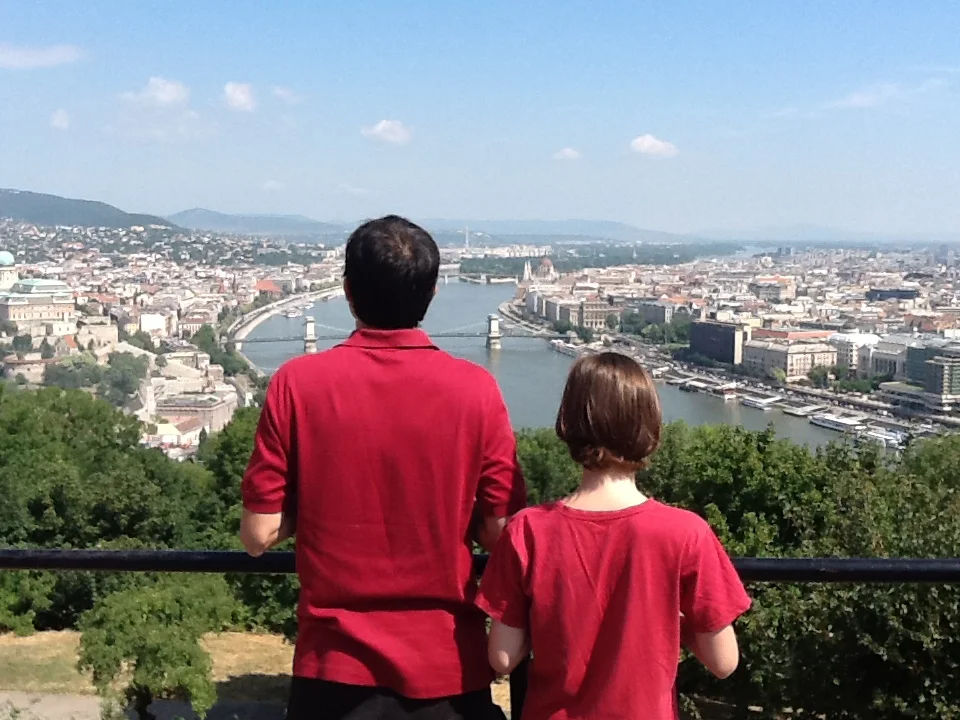
Ken and Titus overlooking the beautiful city of Budapest, home of the Budapest Lectures.
3W SERIES: Reading the Bible in the 21st Century (Part I)
We begin our 3W series on Reading the Bible in the 21st Century today. We invite you to learn a little bit about the Bible and how it can be read in a relevant way even in the 21st Century. We especially want to invite those of you that do not read the Bible regularly or that are not Christians and have always wondered, "What is the deal with this book so many people are hung up on?" This will be based on the work of two very solid Biblical Scholars that are intimately familiar with the complexities of the text: N.T. Wright and Scot McKnight.
THE BIBLE
The Bible is obviously the Holy Scripture of Christianity. What Christians call the "Old Testament" are the Hebrew Scriptures (the Tanak) of the Jewish Faith. Christianity includes the "New Testament" which chronicles the life of Jesus and his Early Followers.
The Bible is not meant to be read as a novel (as one continuous story from one author), nor is it like a textbook. Instead, the Bible is made up of many different kinds of books. And within those books are even different kinds of writings: Poetry, proverbs, history, biography, letters, prophetic books, and apocalyptic books. It's important to look at each part of the Bible in the right context as opposed to reading it like it is one novel or encyclopedia--in one genre.
There is an over-arching story that brings all of the writing in the New Testament together, and that is the story of God's creation, man's rebellion, and the redemption, renewal process being ushered in by Jesus Christ whose death and resurrection are the climactic moment in the Christian Scriptures.
THE CHALLENGE OF READING THE BIBLE
One of the challenge of reading the Bible is that it can be easy to read into it what you want to read into it. This is a concern for scholars and pastors alike (or it should be). We do not want to form our opinions and then find Scriptures to support our personal opinions, but we want the text to speak for itself and for God to speak through it. This can get very subjective, so that's why both Wright and McKnight wrote their books.
Wright says, "Almost all Christian churches say something in their formularies about how important the Bible is. Almost all of them have devised ways, some subtle, some less so, of ostentatiously highlighting some parts of the Bible and quietly setting aside other parts."
Ouch! Yes, that can be easy to do. That's why it's important to read the Bible on the Bible's terms. Wright elaborates:
Some Christians seem to regard the whole Bible, from Genesis to Revelation, as equally authoritative and valid--even though Jesus himself, according to the gospels themselves, seems to have set aside the food laws and posed severe questions about the observance of the Sabbath; even though Paul is shrill in his insistence that the ancient command to circumcise male children is no longer relevant for followers of Jesus, and even though the the Letter to the Hebrews makes it abundantly clear that the detailed regulations about the Temple and the sacrifical system have been made redundant by the single sacrifice of Christ, the great High Priest. Other Christians, meanwhile, have taken Paul's saying that "Christ is the end of the Law" as giving them cheerful permission to ignore anything and everything in the Old Testament. Is there a way through this problem? The Bible itself declares that all authority belongs to the one true God and that this is now embodied in Jesus himself. The risen Jesus, at the end of Matthew's gospel does not say, "all authority in heaven and on earth is given to the books you are all going to write," but "All authority in heaven and on earth is given to me."
Christians have always treasured Scripture, but initially, there wasn't one cohesive, nicely packaged Bible as their is today. Instead, the Scriptures were memorized, transmitted orally and eventually written down. Extremely intelligent men like Origen, John Chrysostom, Jerome, Augustine, Aquinas, Luther and Calvin helped the church look at the ancient texts in Hebrew, Greek, and Aramaic and helped the church to come up with a trustworthy interpretation of this Scripture. There were disputes (some Scriptures are not found in the Protestant Bible, but are found in the Roman Catholic Bible and Eastern Orthodox BIble)---but these disputes about the Scripture are pretty minor in the big scheme of thing. The overall Christian story and the purpose of the books has been pretty much settled for 2 thousand years. It might not seem that way from turning on the TV, but it's true.
SOME CONFUSION
Initially, the ideas of those smart men were so respected that they helped establish the tradition of how we read the Scripture. But in time, the Christian Church's were making the Bible too inaccessible to the average person. Interpretations were getting warped, so there was a need for correction. With the advent of the printing press and higher literacy rates, people began to read the Bible for themselves instead of hearing it read by priests.
For Protestants this was a great moment. Everyone had access to their own personal Bible. Martin Luther was a key reformer in this area and the concept of "Sola Scriptura" was born; meaning "scripture alone," instead of traditions totally controlling the meaning of the Bible. Eventually, this would become important to Roman Catholics as well.
Actually, the Roman Catholics and Eastern Orthodox had good reason for being concerned at the idea of everyone having access to the Scriptures. It sounds good, but one possible problem is that you can end up with everyone interpreting the Bible however they want. And that is what has happened.
For the most part, the many denominations and movements that came out of this period of Scriptural Freedom still held to Orthodox Christian beliefs that the disciples and early fathers would have approved of. But it did become pretty messy in time and this is why the books of Wright and McKnight are important. Because some Christians have forgotten that there are rules to reading Scripture. Meanwhile, on the other side, some Christians and secular scholars have remembered some of the key rules and principles, but then taken that too far. Thus the Bible Wars are born. Wright hits upon this:
Simplistic affirmations ("the Bible says") on the one hand, and counter-affirmations ("You read the text naively; we read it in context, and that changes everything") on the other, only get in the way of serious debate."
So how can you really figure out what the Bible is saying? Is it easy or is it hard? What kind of mistakes are being made? How do we correct it?
All of this will continue to be explored in Part II of this 3W Series: "Reading the Bible in the 21st Century."
Introduction to the Series: "Reading the Bible in the 21st Century" was here.
Oldhams Visit Berlin
Tomorrow we have some very special visitors coming to Berlin. The Oldhams will be visiting us in Berlin. Ken, Titus and I will be heading to Budapest for the Budapest Lectures (summer edition) at the end of this week. Meanwhile, Keli, Zeke, and Grace will be staying in Berlin with Jamie and Marco. Then next week, we will all be here together giving the Oldhams a much needed vacation and hopefully encouraging them. Kelley and Rhonda will be back from German Teen Camp and it should be a great time. Here is a special message from the Oldhams:
Hello supporters...
Thank you for your concern and prayers for us over the past several weeks. We have tried to respond to each email or message that we have received, but if we haven't responded to you, please know that we have sincerely appreciated your encouragement.
We have continued to be at peace and to be safe here in Cairo; however, we have not been able to do much ministry in the last few weeks due to continued demonstrations in the areas where we would normally be meeting, and/or interrupting the route for those who desired to participate. Though safe, it has been a bit of a "house arrest" feeling here due to the possibility of demonstrations and "anti-American-government/media" sentiment. Please note the focus of this frustration; we have had several Egyptians go out of there way to express their appreciation of us or our family being here, they're just not happy with the government or the media for one reason or another. We avoid demonstration areas, but trouble can spring up anywhere at this time. We have been able to go out during the day, we are careful to come back before the evening, and when we do go out, it is in limited areas.
Titus and Ken had been scheduled to participate in the Budapest Lectures, July 25-30; however, it is not a good time to leave Keli, Grace, and Zeke at home in Cairo alone as many of the Egyptian Christians we serve have relocated to the coasts for the summer, and most of our expat friends either left at the start of summer or have been subsequently evacuated in the last few weeks. As a result, Global Missions has given us permission to retreat to Germany for a few weeks; they have given us permission to leave any time we feel threatened--that is not the case in this instance, but we could use the break!
Thanks to a gift from Ohio ChoG ministries, our family will fly from Cairo to Berlin on Tuesday, July 23. We will stay with the Nachtigalls and have the opportunity to visit with them and the Phillips family; this time with our 3W teammates in Berlin will help us all breathe a little easier--literally and figuratively :) From there, we can keep in touch with the leaders in Egypt via e-mail, and we will continue to monitor the events in Cairo as the interim government continues to move the country forward. If all is still well, we will return by August 9 and prepare to jump back into several different ministry opportunities planned throughout August. School is set to start on August 19, and that date has not been changed.
We hope to have the July newsletter out at the end of the month, and there should be some Berlin and Budapest pictures to share with you.
Thanks again for your prayers and support. If you have any questions, feel free to contact us.
Hope you're having a great summer...
Ken & Keli Oldham

Interview with 2013 3W Intern Jessica MacDonald

This summer we had the privilege of having Jessica MacDonald of Fairfax Community Church in Fairfax, Virginia serve as our 3W Summer Intern for 2013. Jessica lived with us, served alongside Rhonda Philips at Neustart working with women caught in sex trafficking, attended the "Global Fellowship Weekend" by visiting the church plant in Arco, Italy, and attending some classes at Fritzlar Bible College.
Jessica is a student at the prestigious college William & Mary in Williamsburg, Virginia. She is interested in neurology, French, and Arabic. We know the Lord has great plans for her life. Jamie and I sat down with her to ask her about her experiences this summer.
3W: Where do babies come from?
Jessica: A cabbage patch.
3W: Okay, J-Dawg, tell us about yourself and where you are from?
Jessica: I'm from the Washington D.C. area.
3W: You are a college student at a very prestigious school, which means you are very smart. What are your main areas of academic interest?
Jessica: Definitely languages, French and Arabic are the primary ones. Definitely the sciences, I started out thinking I was going to be a chemistry major. Then I switched to neuroscience because I was interested in psychology and how the brain works, and then I thought maybe I would go back to biology which I had thought about doing in high school because I also do love that very much.
3W: What were your impressions of the city of Berlin?
Jessica: I love it. I want to live here. It's very cool. Very clean. Although the people are a little more closed off, i didn't feel like I was a stranger. I adapted easily to it. I love that it has a feeling of newness, and an urban vibe to it. It's an interesting mix because it can feel fast-paced, but since there's nature everywhere, you get the feeling you can relax.
3W: What were your impressions of Neustart Cafe?
Jessica: It was really nice. It was really hard picturing it before I came. I tried to describe it to my friends, but I didn't even understand it very well. (I knew) it provided a safe space for some of the prostitutes in the city, but I didn't have a mental image of what it looked like or what I would be doing. The first day was kind of challenging because a lot people were speaking German. There are different people every day, so sometimes there are more English speakers, sometimes there are Hungarian speakers.
But as I kind of eased into it and got to know the other workers better and got to develop relationships with some of the women better, it was really nice. Even though a lot of the stuff was heavy, and shocking to some people, I always had fun. The way I gauged it was as I was telling my friends, "This woman is a heroin addict, she got robbed, but don't worry, she's okay and she's really sweet." I never felt in any danger which was a big factor.
3W: You did something special there?
Jessica: I painted the women's nails. Rhonda and I were in the office and I found this little manicure-box of nail polish--and I said, "Is this yours?" And she said, "We do it for the women sometimes." And so I said, "I want to help." That helped me feel more comfortable there especially as I tried to learn more conversational German. I could speak about their families and what they like to do while we were having a little spa time.
3W: How was working with Rhonda?
Jessica: Super. She is my babushka. Momma Rhonda.
3W: How did you feel about Italy?
Jessica: It was pretty spectacular. It was cool being in a new culture. the sights were really pretty. I loved swimming and going to the lakes and beach. The church at Arco was quite an experience. Especially just following along as they are preaching in Italian and I do pick up a couple of things. I don't think I've ever had an experience like that where I didn't know the language and had to pick up little details and really on the translation. I loved doing worship in Italian (they had the words up on the screen), so I could feel it out.
3W: Then you had the opportunity to hang out with the students at Fritzlar? What did you think of the students and the school?
Jessica: It was so nice hanging out with kids my age. It was good to challenge myself with the language barrier and in other ways. Breaking bread together, sitting in class together, and joking around, you don't have to understand each other to get along.
3W: What was it like having a 10 year old brother for the summer?
Jessica: It was interesting. I don't have any younger siblings. It was fun. Except one time when I hit him in earnest because I was not having it, and I thought this is what i would do to my brothers, but I thought, "I'm not related to him." But then later, I disposed of 6 bugs and he wasn't mad anymore.
3W: You redeemed yourself. What's your big take-away from this experience?
Jessica: That it's okay to have lots of Christian friends that I get along with. That it's okay to focus on my personal relationship with God and let that direct me with in my relationships with other people.
Growing into my faith as an adult and getting past all of that childhood suppressing stuff, like you can't be angry at God or have problems, or put on a facade.
3W: So you feel like you found some spiritual freedom in this experience an in your Christian faith?
Jessica: I'm coming into adulthood and finding my own faith.
3W: What's the most awesome thing about hanging out with Patrick?
Jessica: The first weeks, when it was just Jamie and Marco and I were awesome. But I learned how to impersonate you and I'm getting ready to take your place. It's okay that you are here, but I'm going to take you out. (Singing L.L. Cool J together): "I'm going to knock you out, Mama said knock you out."
Whenever I say something funny you affirm me with a fist-bump.
3W: You are very funny! But I am ready to to put you on the plane. Alright J-Dawg. Peace, and respect. Ali G "Respect."
