

THREE WORLDS DIARY
What to do with the Muslim Brotherhood?
Upon seeing the recent events in Egypt, the question now lingers, "What to do with the Muslim Brotherhood?" Since they cannot govern well and obviously want an Islamic Theocracy, it would be nice if Egypt started over and kept them off the ballot box next time. However, that may not be so easy nor might it be wise. It won't be easy because there are other groups that can take up the mantle and have not been banned, and the MB could fracture into different Islamic parties that want to be in the political process.
If the parties are banned altogether, it plays into the suspicion that the Islamic parties have, which is that democracy should not be trusted and the system is rigged against them. Consequently, there could be violent rebellion. But if they are included, technically an Islamic Theocratic party could win--or there could be quite the bloody war between various splintered parties. But there's a lot more to consider.
Morsi and the MB ended up running the Egyptian economy into the ground, past the point of no return. They acted like a closed, secretive organization and alienated just about everyone in the whole country. Can this even be considered a political party? Or was it a group of MB insiders doing their own thing--no matter what the cost to the Egyptian people. Could Egypt have lasted much longer under their leadership? They were burning through Egypt's reserves, not delivering bread and fuel, and scaring away foreign investors by the hoard. How could this have gone on for 3 more years unchecked?
Complicated questions, but here are some articles wrestling with the issues, but coming from different angles.
Here's some articles and comments that offer a glimpse at the tricky way forward.
Hazem Kandil via the London Review of Books defends the ouster of Morsi and argues that this is part of a long revolutionary process the Egyptians are embarking on.
David Brooks of the New York Times argues that Islamists should not be allowed anywhere near the government of any country if people want that country to work.
Daniel Larson at the American Conservative is against rigging the system against Islamists in Egypt.
Daniel Levy at Al-Jazeera distrusts the Egyptian military and felt that it was too early to pull the plug on Islamic groups in Egyptian Politics.
And a very helpful article from the New Republic about things to think about and not think about regarding the latest developments in Egypt. A "road-map for backseat drivers."
Revolutions always take surprising twists and turns--and usually last a lot longer than we would like. Keep praying for Egypt and all of our friends there.
Some Thoughts on Dying...and Living
A few weeks ago, I went to the doctor and he was pretty alarmed at what he saw. So while in the U.S.A. on a brief business trip, I visited my American doctor and he was pretty alarmed too. I've had a pretty busy schedule so getting more tests and follow-up has not been easy. But today, I went and the specialist looked at me and said he feels that I am going to be fine. Obviously, I will continue getting tested and will be careful, but he really feels it's okay.
Both Jamie and I are always prepared for the worst. Having parents die of cancer before your very eyes when you are young (and they are young) makes you lose that sense of immortality pretty quickly. Every day is a gift and can't be taken for granted.
I've nearly died 4 times in my life. The first time was when I was an infant and was abandoned and nearly starved to death in a Costa Rican orphanage. I don't have memories of that, my body and my subconscious do. Near starvation and abandonment leaves an imprint on you no matter what age that it happens.
Then there was a second time when I was 16 and went flying off a freeway in Oregon, spun around in front of traffic and ended up in the middle divider---the car totaled (Sorry Dad!). I narrowly missed a lot of cars and fortunately did not kill anyone; but I survived--and remember feeling an incredible sense of peace and calm as the car was airborne and flipping around. No shaking, nothing. Just calm.
The third time was in New Haven, Connecticut. There was a very dangerous bridge that we had to cross every day called the "Q Bridge". Connecticut drivers are some of the fastest drivers in the USA (if not the fastest). And the freeway infrastructure around New York City is some of the worst, including New Haven. Everyday we had to merge onto a bridge at top speed, and had about half a mile to move over 4 lanes to our exit. The bridge bent at the middle so you were blind for the second half of that half mile on the bridge. I think they have since improved it.
One day on my way home from school, I sped onto the bridge (as you have to), and made my way across the high speed traffic into the 4th exit lane. But as I reached the 4th lane, the "blind" half of the bridge was now visible, and there was a car parked--totally still--in that 4th lane.
I slammed on the breaks as I was headed straight for the parked car. The car literally screeched to a halt with about 1 inch to spare. I felt a sense of relief and amazement that I had actually been able to stop...and then I looked in the rear-view mirror. A full semi-truck was speeding right at me also trapped in the right lane. I'll never forget the image of that semi-truck barreling down on me.
There was literally no way out. Both my car and the other car were completely motionless. As I looked in the mirror, I remember thinking "This is the end of life." And I felt totally calm and peaceful. I wasn't even afraid of pain because it was so obvious there would be no surviving this crash. It was just obvious it was over.
Miraculously, the semi-truck slammed on his brakes and he too stopped one inch or so from my bumper. The grill was enormous in my back window. It looked like an overly-fake scene out of a TV show. Something you might see on CHIPS or Starsky and Hutch. It was unbelievable! The next thing I remember is the semi eventually pulling out and yelling down at me. I quickly followed on his tail wanting to escape the death lane. And as I drove past the car that had parked in the middle of a bridge, there was a guy just calmly sitting in there (trying to commit suicide perhaps?). I wanted to kill him, to be honest, but I gunned past him to get off on the exit and avoid the crazy high speed "Q" traffic. There was no way to get out and chat or see what was wrong. It's just not possible on that bridge. You speed by or you die--especially on the blind turn. I still wonder what that guy was doing. He could have died, I could have died, and maybe he died a few minutes later! You can't park in that lane on that bridge and survive.
The fourth time I nearly died was in a hospital in Hong Kong. My medical incident there was one of the "two worst cases" my Doctor had seen. When i went in to the operating table, I remember saying "goodbye" and thinking it was the last time I would ever see Jamie. It was sad but the situation was so obviously grave, I just knew I needed to be on that gurney if I was to survive at all. The only reason I had gone to the hospital (amidst a lot of pain) was because as I was lying in my bed in pain, a small bird came against my window and knocked up against it. The same exact thing happened the morning my mother died, as I sat by my window those first few hours without her. (Some Africans believe a bird will always find you after someone you loved has died). So I went to the hospital and they rushed me into the operating table... And I felt totally calm and peaceful. The doctor said I was 2 hours away from dying. Had he left his shift, like he was supposed to, I might not be here. Instead, at midnight, I had the operation. After that i took another turn for the worst and it was touch and go again. It was a couple of weeks before I left the hospital and several months before I was free of pain, but I made it.
And then there have been the last few weeks--of wondering if there was something really bad going on inside of me. Although perhaps not as grave as these other incidents, I still thought a lot.
These moments of near-death have been blessings to me. A reminder that life is fragile, that every day is a gift, and that we have to make life count. Those are cliches, but it's amazing how very true and profound those thoughts become when you really are facing death. Another cliche: You are not worrying about your stock portfolio or your job when you are dying. You are thinking of your family and friends.
But for me, I ask myself other questions: "Did I take enough chances in life?" "Did I gain some humility and perspective about my place in this universe? "Does my life have congruity?" "Does life seem fair?" And "Did I love people well enough?" Two bigger questions: "Was I a good husband?" "Was I a good Father?"
And the biggest question of all: "Do I really believe in my faith in the darkest times?"
The answer to that last one is always "Yes." And I think that is always why I find a sense of calm and peacefulness in these close calls. I can't say I got it right in life. I can't say I don't have any regrets. I can't say I've loved as much as I've been loved. I wish I could. Regrets? Unlike Frank Sinatra, I have many.
But I can say that I believe in this amazing faith of Grace. And from there, everything else can be handled.
I do think there are many greater tragedies in life than death: Never growing up, being conquered by anger, failing to take chances, wallowing in bitterness, not laughing, not growing up and maturing, never finding your meaning in life, not learning your limitations, and not loving people selflessly. These and many other things are worse than death. But while we are alive, we always have the chance to find redemption and renewal.
I'm not a country music fan, but I love this song by Tim McGraw, and the message is so profound. Listen to it and live like you were dying.
(Version 1 plays in the USA)
(Version 2 has lyrics)
(Version 3 works outside of the USA)
***
"and I loved deeper
and I spoke sweeter
and I gave forgiveness I'd been denying
and he said "Someday I hope you get the chance to live like you were dying."

All Eyes on Egypt...and our Friends
We just finished a conversation with the Oldhams-- our 3W personnel in the Middle East. They are in great spirits, they are there usual calm selves, and they are prepared for whatever may come. So are we. We stand by ready to assist them in any way necessary. We are all monitoring the situation very closely and taking embassy warnings very seriously. The safety of the Oldhams is our primary concern.
For those of you not following the situation in Egypt, it has been a year since President Morsi took charge as Egypt's first elected leader after the fall of the Mubarak regime in January of 2012. Over this past year, President Morsi, representing the formerly persecuted Muslim Brotherhood, has made a number of alienating decisions that have led to widespread calls for him to step down. June 30th is the day when enormous numbers of Egyptians are expected to take to the streets (both pro-Morsi and against Morsi), as millions call for Morsi to vacate the office of the Presidency permanently, and for new elections to be held as soon as possible.
One of the most difficult parts of our line of work is never knowing how long our temporary "home" will be home. For many of us, there's constant uncertainty--if not about the stability of our country, then of the stability of our rental agreement or current location. Unexpected moves and certainly traumatic evacuations are never pleasant experiences. Fortunately, we have a large group around 3W that are prepared to help the Oldhams with anything that may come.
We are also concerned for all of our dear friends in Egypt and the wonderful churches we know there. As I've said to people on various occasions; the two friendliest countries I have been to are: Egypt and the Dominican Republic.
Egyptians should not be lumped in with the other volatile cultures in the region. Egyptians are funny, humble, and love life and peace. It's an amazing country with an ancient civilization and we pray that the best days are ahead. Thank you for your support!

What It Takes for Global Fellowship
The 2013 Global Gathering of the Church of God is in the books in both the USA and in Europe and the Middle East. In this region (E/ME), we had churches and groups fan out across the region to celebrate the "Global Fellowship" weekend. Early reports are that it was a great success with everyone walking away wanting greater connection and fellowship.
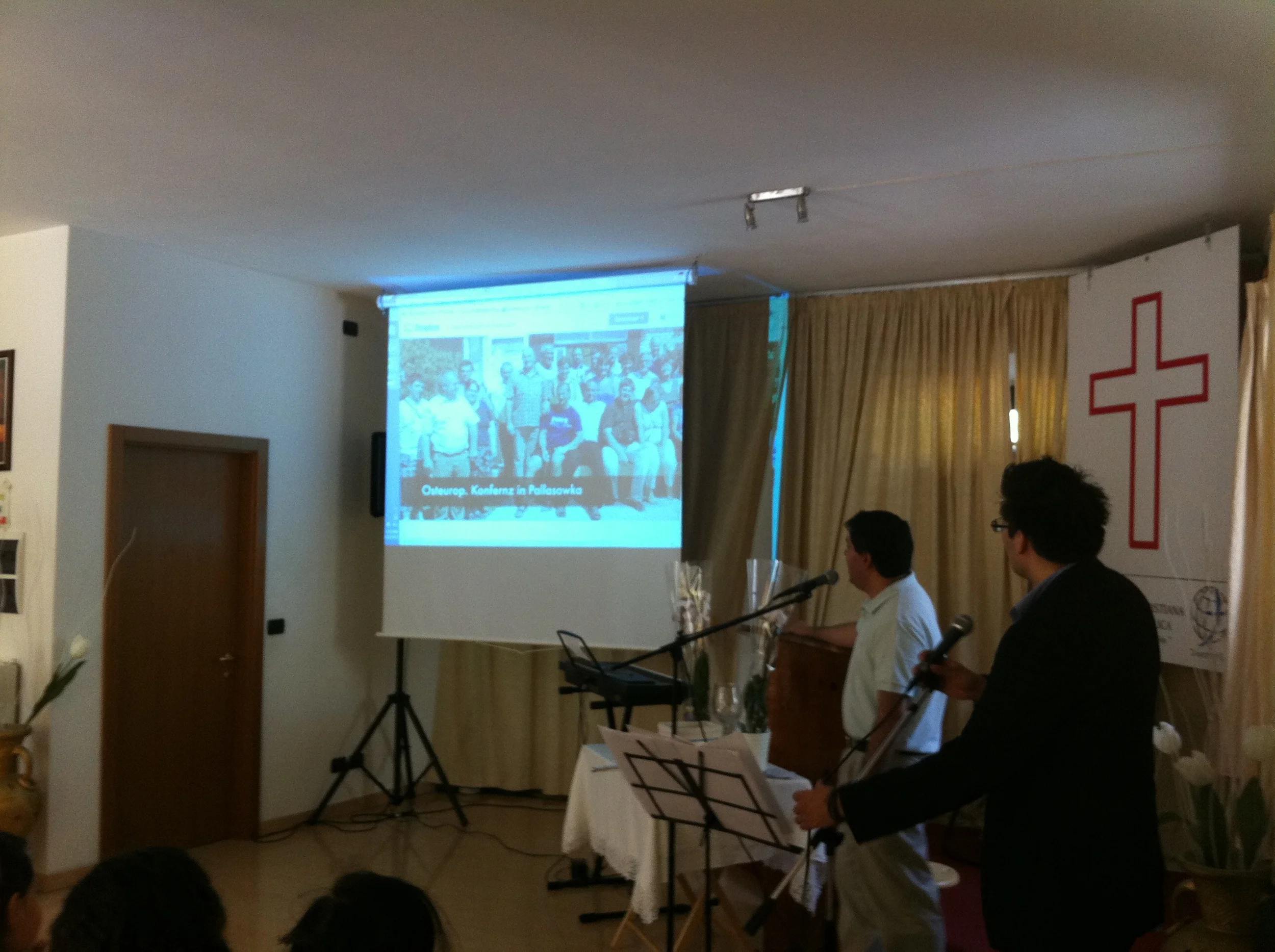
Jamie, Marco, 3W Intern-Jessica MacDonald and I headed South to Italy to be with our friends in the Arco Church of God in Arco, Italy. The Church is new and small, but it is growing and there's clearly a core of committed lay people forming which will help propel it to greater growth in the future.
Jessica and I attended the youth event on Saturday night and we were extremely impressed with the quality of the youth lesson. Marcos Lovaglio did a fantastic job asking us what our image of Christ is and what we think his image of us is. It was important, because as Marcos explained, that impression really sets the tone (and parameters) for your relationship with God. It was a deep question and a thoughtful presentation. I'm so happy to see the youth group in Arco not just existing (not easy for such a young church plant), but growing AND leading worship. I think this is an excellent start.
The sermon by Pastor Lovaglio was excellent. Then we shared about the Global Fellowship and showed video of fellow Christians in our movement doing ministry. The Arco church will continue being a part of this fellowship.
The church people expressed how grateful they were to not be left out of this big event. The four of us were so glad we made the trip down to Arco to remind them that they are not alone! Many of us are praying for them and want to walk alongside this special church as it grows.
People always greatly enjoy these events that bring us together for a week from around the world. There's always a call for more. But one of the big lessons from "Mosaic" is that much of what we do in the Church of God actually encourages Balkanization instead of unity. I won't go into all of that now. Suffice to say that one key piece missing from every region to really create regular unity has been some organizational structure or mechanism that strives for regular connection.
In the old days, the Gospel Trumpet/Vital Christianity magazine achieved that connection to some extent. The old World Conference did as well, but that was not very frequent. The Church of God is so atomized around the world and has such a lack of structure and authority that there's not many ways to really bring everyone together with the INTENTION of creating international connection.
That's why the third part of our 3W Prism is "creating inner-connectivity in Europe, the Middle East and beyond." Because there has to be some organization that takes upon itself to make sure that this is happening more than just every 2 or 4 years. Isolation is not good for the soul. That goes for churches and countries as well. One of the most important things Three World's does is bring people together on a regular basis. Upon returning for Italy, it will be time to start finalizing the Summer Budapest Lectures which will be bringing together Bulgarians and Hungarians as well as Ken Oldham (3W-Middle East) for this regular event.
If the Church of God wants to have a regular event like the Global Gathering and more importantly, see an increase in synergistic relationships around the world, they will need to create the organizational structure, but also create an "ethos" that values partnership and cooperation instead of isolation and autonomy.
My hope is that the younger generations will push unity and synergy more. We can all, for instance, be a part of the success of Arco. The Kingdom expands better when we all help each other.



Welcome to the New Three Worlds Website!
Greetings to our friends around the world! And Greetings to those of you attending the Global Gathering and just checking into Three Worlds for the first time.
This week is the Church of God Global Gathering in Anderson, Indiana and the simultaneous "Global Fellowship" occurring in Europe and the Middle East. Delegates from over 8o countries are descending on Anderson to celebrate together for 5 days.
Meanwhile in our region (Europe/Middle East) the "Global Fellowship" is happening in cities throughout the region. Churches from different countries are sending teams across borders to spend a weekend celebrating and worshipping God together while the larger event happens in the U.S.A. At all of our sites (U.K., France, Italy, Bulgaria, etc.) we will be raising funds for the Persecuted Church and connecting with Church of God countries in other parts of the world.
Consequently, we decided to unveil our new Three Worlds website this week. This website has been active for 11 years. It began in 2002 as www.chinatimesonline.com. It stayed that way through the duration of our time serving as missionaries in China. But in July 2010, we launched www.three-worlds.com. This is our first major change from the original 3W site and we quite like the smoother look and the clarity.
The "Diary" is our main feature. It's a blog that has been running for 11 years with new entries on average every 3 to 5 days. It has been a great way to record our thoughts, capture our experiences, and discuss in-depth various issues related to missionary work, Christianity in general, and Global politics and trends. It is also a place where we post trip reports from our many trips around Europe, the Middle East, and the World. What we can't talk about in depth at Facebook (Three Worlds) or Twitter (3WCHOG), we can delve into deeply at the Diary. So be sure to bookmark the diary page and check in on us often.
We are very excited about the future! Three Worlds has really taken off and we aim to continue being a place where we "Prepare the Church for Ministry in the 21st Century." Thank you for joining us and get ready for an exciting and wild ride!
Is Evangelical Worship Superficial?
Excerpt #1:
Entertainment has apparently become many people’s primary purpose of existence. I doubt that it would surprise Pascal that the world has increased the size, scope, and comprehensiveness of distraction. It would not puzzle him that death has been reduced to little more than a comic-book cartoon in countless action movies or into a mere momentary setback in soap operas and sitcoms. Indeed, he would not find it perplexing that the bleak spiritual violence of mortality leaves no lasting mark on the bereaved in the surreal yet seductive world of popular entertainment.
But he might well be taken aback that the churches have so enthusiastically endorsed this project of distraction and diversion. This is what much of modern worship amounts to: distraction and diversion. Praise bands and songs of triumph seem designed in form and content to distract worshipers from life’s more difficult realities.
Excerpt #2:
Of all places, the Church should surely be the most realistic. The Church knows how far humanity has fallen, understands the cost of that fall in both the incarnate death of Christ and the inevitable death of every single believer. In the psalms of lament, the Church has a poetic language for giving expression to the deepest longings of a humanity looking to find rest not in this world but the next. In the great liturgies of the Church, death casts a long, creative, cathartic shadow. Our worship should reflect the realities of a life that must face death before experiencing resurrection.
It is therefore an irony of the most perverse kind that churches have become places where Pascalian distraction and a notion of entertainment that eschews the tragic seem to dominate just as comprehensively as they do in the wider world. I am sure that the separation of church buildings from graveyards was not the intentional start of this process, but it certainly helped to lessen the presence of death. The present generation does not have the inconvenience of passing by the graves of loved ones as it gathers for worship. Nowadays, death has all but vanished from the inside of churches as well.
Read the whole thing here: http://www.firstthings.com/article/2013/05/tragic-worship
***
Criticism of contemporary worship is nothing new. It often revolves around whether we are influencing the culture, or whether the culture is influencing us. ”Did we abandon classic hymns so that we can sound relevant in our churches?” “Is the sound of drums and guitars less reverent than the sound of choirs, an organ, or a piano?” And a deeper critique has been, “Are the lyrics presenting good, sound theology as many of the old hymns did?” ”Or are they shallow, slogans?”
But this article suggests something much more troubling. That our modern worship intentionally tries to shield us from the tragedy of our fallen world. That we want the happy, re-assuring gospel, and not the gospel that spends a lot of it’s time not only talking about denying ourselves and taking up our cross, but that we refuse to believe there are consequences to the fall that we will not defeat in this world.
In my Wesleyan-Holiness upbringing, I never heard the Fall talked about seriously. It was clear that there were many things that were sin, but we were to stay away from those, and with Jesus’ help, all should be okay. It wasn’t quite Joel Osteen, but it was uncomfortably (or comfortably) close. Our Wesleyan-Holiness tradition and Joel Osteen do have something in common. Their theology has a uniquely American, triumphalistic element to it that seems to assure you that the good guys always win. ”Your best life now.” ”We can totally defeat sin.” ”We will have the victory.” Yes, of course we knew that there were problems in the world and that the best would come in the next world, but there was a subtle and not-so-subtle-suggestion that a good Christian is always optimistic, happy, and victorious.
The truth is though, that many of the Christians I know (myself most of all) are not always optimistic, happy, and victorious. In fact, we can often be the exact opposite: discouraged, depressed, and at a loss for how to manage the challenges in our life–despite our love for the Lord and our faith in Jesus. It often leads to a disconnect in the Christian’s life: ”All the language, music, and people I hang out with say I should feel joyful and victorious every second of the day, but I don’t really feel that way. What to do?” The answer is either: 1) Hide the truth about your feelings or 2) Deny that you feel that way.
A theology that takes the consequences of the fall has answers for this. This world is not currently in the state God intended. In fact, it is far from it. Yet through history and through the life and sacrifice of Jesus, a massive redemption process is under way that will lead to a world that will be the fulfillment of our deepest desires. Where we will finally feel at home. Where we will be who we truly want to be at our deepest core. I describe it as the feeling you have when you get back to your house from a long trip away. You enter the door, take off your shoes, and are suddenly overwhelmed by a feeling of familiarity. This is your shelter, this is your refuge, this is where everything feels comfortable and you can truly let down and be yourself. It’s good to be home and sleeping in your own bed.” Heaven will be that kind of feeling, but on a much more profound level. ”Ah, this is what I always wanted and who I really am deep down. I am home.”
But that is the next world, not this one. ”My Kingdom is not of this world,” Jesus said. Yet he also proclaimed that the Kingdom had arrived. What he meant was that the great climax of the process of redemption had started: his work on the cross and the resurrection. But he did not mean that this current world would suddenly be a perfect and just place. Quite the opposite, he warned that it would get worse before it would be better.
But do we ever want to think of how it is worse now? Do we mourn for what could have been and what is? Do we acknowledge that there are deep needs and desires in this world that will go unfulfilled in this lifetime? I wish my Mother were alive. I wish she could see me now. I wish she could know my son. But she can’t and she won’t in this life. And that is a tragedy. Do we sing about that in church? Do we talk about that in church? The Bible has lamentations, and the church fathers talk about the tragedy of the fall, and Augustine talks of the corruption of beautiful things that sin brings to the world. But is it in our music, our sermons, and our Evangelical culture?
This article suggests its not, or it is not enough. I tend to agree. The more I walk the Christian life, the more I see how hard it is and how much we have to understand why we fail and why others fail. Nothing in my spiritual upbringing really prepared me for how I would need to deal with my own failures, disappointments, disillusionments, and the failures of others. “Perfection,” “Holiness,” and “Victory” are what I grew up hearing all the time, but I did not see it and I could not be it. How to explain the disconnect?
It was only after discovering Eastern Orthodox theology in 1991 and later Roman Catholic theology that I began to even have a sense that there was a Christianity that didn’t have quick, pat answers. Within my tradition, (the Church of God, Anderson, Indiana) it was the work of Val Clear and Gene Newberry that prevented me from thinking I was a heretic.
The irony of theologies that don’t take the fall seriously (too negative and dark, not triumphalistic enough), is that they end up being dualistic (we’re good, everything else is bad). Only the God stuff is great. Everything else in the world is evil. So darkness doesn’t penetrate our lives or our worship, but it is a threat all around us. Ultimately, to me, that’s bleaker than a world tainted by a fall. That kind of manichean worldview is hard for Third Culture Kids to swallow and it just doesn’t seem authentic.
So the idea that our worship and faith really avoids death and loss sounds right on the money to me. Surely, some Church of God people will say, “our theology does reflect the reality of the fall, read page XX of so and so.” But, as this article suggests, it’s what we really proclaim daily and weekly that matters. We’re good at proclaiming “victory.” Not so good at proclaiming, “things are not always right, even within us.” You can even see it organizationally within the Church of God. It’s deep in our DNA. Denial.
I’ve been in meetings with other Christians where everyone was supposed to share their true hurts, pains, and fears. But as soon as people started doing that, the pat answers came flying out at the speed of light. There was no freedom to really express pain and frustration. No room to mourn. It was almost comical how no one was allowed to really express their darkest feelings because that wasn’t perceived to be true faith.
Once, Jamie and I attended a camp for wounded missionaries. It was one of the most incredible experiences of my life. Only there (NOT in church) were people free to vent their deepest pains, frustrations, and sorrows. I left wondering, “Why can’t church be this way?” It was intimate and it was real, and the effects of the fall were evident for all to see. And they were in the Scriptures we studied.
I don’t think I was very well prepared for reality theologically-speaking. But there were friends along the way, chief among them, my good friend Dean Abbott, who began showing me a more wholistic theological view that has brought more freedom. And that freedom (in that paradoxical Jesus way) has brought a deeper understanding of life through death.
The German Transformation
Last night, I had the honor of getting to speak briefly to the students of the Fritzlar Bible School. They have been here in Berlin examining the religious and historical sights of the city--including the difficult ones that are associated with World War II. The students expressed their dismay and frustration that Germany could have been a place where neighbor turned on neighbor and a global tragedy unfolded. It's still painful and hard to believe all that happened in World War II for Germans. And it can be discouraging.
But as I spoke, I wanted to point out that they should be proud of Germany and of Berlin. The transformation that has occurred in this country since 1945 is nothing short of miraculous. First, West Germany became a place that was open to people from all cultures, ethnic groups and racists. It became a place where multi-culturalism was supported by government and the country quickly became amongst the most peaceful of nations in the world.
The city of Berlin remained divided (Socialist East Berlin and Capitalist West Berlin) until 1989. But then, in a mere 10 years, this divided city re-invented itself. It became not only the capital of Germany once again, but it also became Europe's cultural center (surpassing Paris), the heart of the arts in Europe (where many of the artists are Israeli Jews) and a city with 40% of its citizens holding a foreign passport. An extremely high percentage of children under 10 in Berlin have a parent from another country. Berlin is synonymous with tolerance, openness, and multi-culturalism. From 1945 to the present day, Berlin is proof that societies can change dramatically for the better. I'm proud of Germany and proud of Berlin, and I think the German youth should be too.
I've lived in countries that are truly racist and have no desire to change. I wrote a post here on the diary not long ago about racism in other societies. Today, Germany would easily be amongst the most tolerant, least racist societies in the world.
Aside from encouraging the students about their German heritage, I also asked the question, how is it that an entire city like Berlin could change it's entire cultural DNA in 10 or 20 years, but churches often don't change anything for 50 years? The churches that are succeeding in Europe are the ones that are willing to experiment, be out-of-the-box, and create a new culture. It's happening in our churches in the Netherlands, it's happening in Paris, it's happening in Rome, it's happening in Budapest, it's happening in Athens, it's happening in Cairo etc. When re-invention is welcomed and the culture can be changed, good things can happen in churches.
So I look forward to spending more time with these German students that will be change-agents. I'll be teaching there in July and seeing them once again.
Things Heating Up in Greece...for 3W
The hot season is starting to descend on Greece. Located on the Mediterranean, Greece is known for it’s near perfect climate and sun. But in the summer months, it starts to get quite hot.
Things have been pretty for the past couple of years as the Greek economy continues to fall apart. It is starting to hit everyone now, and there’s not just unemployment but a lot of illness, depression, and chaos growing in the country. Fortunately, the Athens CHOG is making a remarkable resurgence. A year ago, the church was close to being finished off. Today, there is a Greek service and an Indonesia service and attendance is up to 50–the most that Church of God has had in easily more than a decade.
Furthermore, new ministries and forms of outreach are happening in the community including a drug rehabilitation program and a drama event that packed the 350 seat auditorium!
This past week we had Pastor Vassilios and his wife Natasha up to Berlin to enjoy some much needed R&R and to discuss future partnership with Three Worlds. We were all full of ideas and are getting very excited to see where all of this is headed. We both believe in high levels of accountability and mutual accountability. Among the things in the pipeline:
*Renovations of the Church as we configure it to host more community events.
*Creating a multi-purpose stage for church, music, lectures, and drama (which includes some equipment and work we will need churches to help with). Already, thanks to Western Canada CHOG, we are able to configure the sanctuary better for the joint Indonesian-Greek services. Thank you Western Canada! We will need rafters for lighting, new lights, headsets for simultaneous translation, microphones, screens, video cameras to record events, a transparent/portable pulpit.
*Dave and Kathy Simpson will be dispatched to Athens to finalize a lot of legal and organizational issues as well as begin some of the renovation work.
*Pastor Vassilios will be joining us in Rome for the 3W Seminar on Church organization in September led by Rod Stafford of Fairfax Community Church.
*Greece CHOG and 3W will be planning an expansion into Romania in December with a trip to Bucharest.
*Kelley and Rhonda Philips will be dispatched to Athens to look at the issues of Sex Trafficking in the church’s neighborhood.
*We hope to have Tri-S become a regular visitor to the Athens CHOG.
*A 3W Seminar on Church Health that will be open to all churches in the Athens area.
*We will begin discussing plans for a youth basketball camp that will be a partnership with the Rome CHOG.
*3W Staff Meeting in 2014 will be in Greece.
*3W and Athens CHOG plan to host some special CHOG conferences in the near future (more details later).
And this is just the beginning! We are so excited to see new life in the Athens CHOG and we are thrilled to be working with Vassilios and Natasha.
Racism Around the World
From Facebook: Three Worlds Is the USA very racist? As a minority, I've always argued that the answer is a strong "no." Race relations in the United States are far better than they are in other places around the world. I used to live in South Korea--and there, all minorities were discriminated against, including me. Many other countries are the same way. Even in brown-skinned countries, a lot of time the prejudice is against darker brown-skinned people. The lighter the brown skin, the better off you are. Racism is a human problem.
Now a survey has been done exposing the racial intolerance of countries. Notice that most of Europe looks good and the US and Canada are very tolerant. India scores very poorly, so does South Korea, and some Arab States. Homogenous populations (S. Korea, Japan), places of ethnic tension (Nigeria, India), and Confucian societies are pretty intolerant.
Societies that have a lot of mixed ethnicity (Brazil, Columbia) or a strong belief in liberal democracy (Canada, UK, Sweden) and/or a Christian heritage that emphasized the value of all human beings did well (the big exception being France).
You could definitely pick through these. For instance, Brazil does have a lot of prejudice against blacks, but people are fine living next to each other (which is the question that was asked in the survey to illicit responses that gauge discomfort with people from other races.
This is not to say that the USA and Europe are perfect (Ukraine and Poland come to mind), but most Western societies are very OPEN about their race problems which makes them seem more concrete. This is particularly true of the USA. On the flipside, there has never been a Korean Martin Luther King critiquing racism in Korea. Racism is not a moral issue in some societies. It is understood to be natural and right. "We ______ are the superior people in the world." The same goes for many other countries. A true movement against racism has been absent in many countries around the world.
I do think that the Christian value of the individual has been internalized in many countries around the world because of the Gospel impacting culture--even if the culture moved away from the Gospel.
Financial Support: The 3W Way
At Three Worlds we support a variety of project throughout the Middle East region. Donors can give to the Cedar Home Orphanage in Lebanon, the new Church plants in Russia, assist the church in Egypt during these difficult days, help the Church of God in Athens, Greece as it helps the less fortunate during the worst crisis since the 1930's, or support the Next Generation of leaders in our region (and our interns from around the world) through the NextGen Fund. These are just some examples of projects we have open in the region.
Some Problems with Money on the Mission-Field
In general, however, 3W is careful with money because missions and money don't often go together well. It's very easy to create dependencies--where churches or countries don't grow on their own. Instead they just wait for the next check from the U.S. Because the Christian culture is a high-trust culture, it's easy to have people in the system that abuse that trust and not use money as donors intended. It's also easy for people to think that money will solve all of their problems, when often it just compounds them in new more divisive ways. It is also a problem when things are constructed (such as buildings or schools) and there's no one there to really manage the property adequately. Many countries can become extremely unhealthy very quickly if the floodgates are opened and money just pours in from North America. Power battles can ensue, a sense of entitlement can be formed, and the church's mission can be more about sustaining its facilities and remittances than it is about actually doing evangelism. Unfortunately, we have seen this too often.
Real Relationship First
At Three Worlds, we do not think the flow of funds from North America to Europe/Middle East should be our core purpose. That, in fact, is low on the list. We do not have many projects in the region on purpose. New project proposals must meet certain requirements and we are only willing to open two a year for the entire region, and even that is not guaranteed. We prefer to spend our time ministering in churches, training, encouraging and empowering the next generation of leaders, as well as reaching out to the young, and creating a regional sense of unity and purpose. Relationship and ministry comes first. The flow of funds from North America to our region is the lowest priority. We have seen time and time again (especially in the Church of God), the more money a mission-field gets over the years, the less ministry you see happening. While those countries that learn to do with what they have, tend to stay focused and grow in a healthier manner.
There is a place for financial support. Often certain projects need to be kick-started, or an infusion of cash can help a ministry come to life or survive a turbulent time. Or assistance for a pastor can help a church plant to get launched. But these should be taken on a case by case basis and the deeper, structural realities should always be examined before the checkbook is pulled out. A need is not enough. There needs to be health underlying that need.
At 3W, we go by an internal plan that we call "RAISE NUT (R-A-I-S-E-N-U-T). The "Raise"principal comes from Jonathan Martin's "Giving Wisely." However, those principles are pretty common-sensical. Why was that book such a hit? It's because the Church of God in North America got so careless, that it started violating even those common-sense principles in their support for missions. Many people got burned time and time again.
WHAT IS RAISE-NUT?
R=Relationship First: This means that it's vital to have a real relationship first that's based on friendship and partnership in ministry, not just an arrangement to enter into a financial agreement to transfer funds from North America to some country overseas.
A=Accountability: There obviously needs to be some pro-active oversight over the funds with the recipients demonstrating clearly that they are using the funds as designated. The missionaries and mission-agency must be very transparent in how they are delivering the funds.
IS=Indigenous Sustainability: The funds given should enable the mission-field to continue operating on its own and not create dependence on foreign funds. It something new is starting, there should be a clear explanation of how this ministry will be funded without outside help in the near future.
E=Equity: The money must not be distributed in a manner that is unequal (one village church gets a lot, the other village church gets nothing), or which begins to separate the recipient from the living standards of those they work with and serve.
At Three Worlds, we also added three more key pieces in 2011 based on our observation that these things can also be problems:
N=Next Generation. Is the country empowering the next generation? Are they putting emerging leaders into positions of influence? Are they doing the things that it will take to make sure that the country will have churches 20 years from now? In some cases, leaders intentionally block young people from leadership (and by younger I mean under 50 even)!. We are very intentional about partnering with countries that are serious about reaching young people and having a future, not just preserving and protecting the past.
U=Unity: Does the project bring unity to the country or the churches? Or does it cause division? Furthermore, if a country is already suffering from a lot of division and divisive behavior, we are highly unlikely to start a project there, which will only exacerbate the problems. There's no reason countries or churches should get money when they have no interest in being united in fellowship with each other. We only work with countries and churches that are committed to unity or willing to work toward unity in humility.
T=Timeline: We want a concrete time-line that tells us when the project will end. We have phased out open-ended projects because it becomes too tempting for mission-fields or churches to become dependent on those funds. In special circumstances, the project may be extended, but only after a careful review; and that review will happen with someone on the OUTSIDE of 3W to give us better perspective and objectivity.
Of course none of these guiding principles mean anything if they are not taken seriously or enforced. A non-profit organization must have standards that it insists on if it is to protect its donors, not create dysfunction on the mission-field, and stay on the right side of the law. But it's easy to get wobbly in the knees when people are making personal pleas. There's a place for compassion, but there's also the need to be fair, ethical, and not become enablers.
For 3W, having standards that we all agree on (donor, missionary, national) makes things run far more smoothly. All of us must be challenged to some extent and reigned in at times. A system designed to do that is going to work better than a purely subjective, unplanned process. Ultimately the thing we value most at Three Worlds is health, because once you lose that, it really damages your witness.
We're happy to be working in this region and happy to see that we are all doing our part in a healthy, accountable way.